
Addie L. Green of Springfield
- Mar 29
- 3 min read
Updated: Apr 12


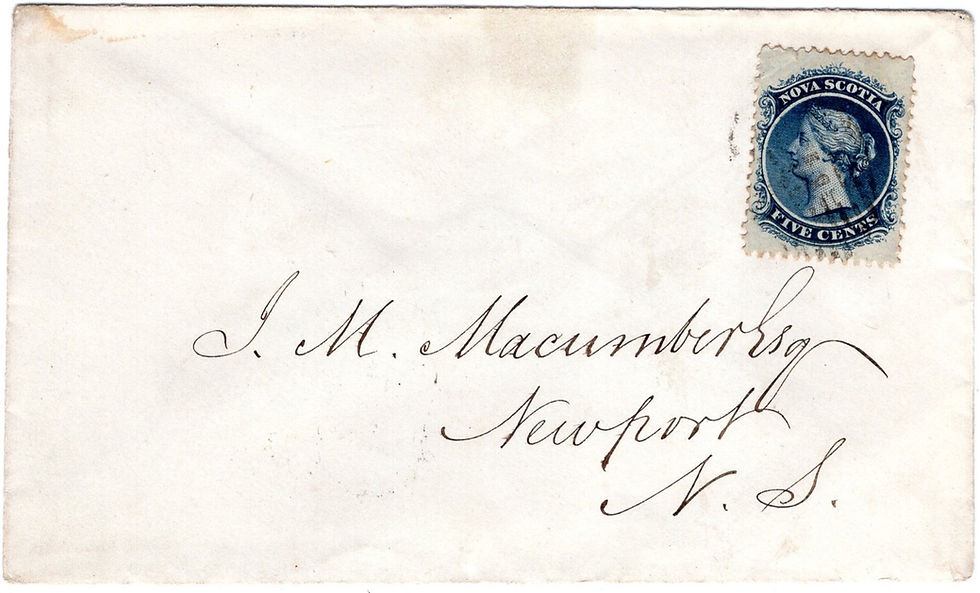
Adaline Luanne Green was 17 and was likely working in the offices of the Springfield Republican when she received this letter from Port Hood, Nova Scotia in 1867. Addie was born February 2, 1849 in Chicopee, Hampden County, Massachusetts, the daughter of Daniel Green, mason (1813-1889) and Harriet Sophia Willey (1819-1874). We do not know what the connection was between Addie Green and Port Hood.
On June 18, 1868, Addie L. Green, 18, of Springfield, born Chicopee of Daniel and Harriet, married Charles Augustus Bly, 25 of Springfield, born N. Adams, of George W. and Maria
Addie died September 30, 1869, aged 20, and is buried in Springfield Cemetery, Springfield, Massachusetts.
The Springfield Republican
Established by Samuel Bowles II in 1824 as a rural weekly, the newspaper was converted into a daily in 1844. From the beginning, it focused on local news. As rapidly as possible, its news-gathering operation was extended until, and within a few years its columns contained items from every town and hamlet along the Connecticut Valley, as well as from Springfield. It achieved national renown in the 19th century under the tenure of Samuel Bowles III, a legacy that was passed to his son, Samuel Bowles IV, and grandson, Sherman Bowles.

Politics
Samuel Bowles, transformed the paper into the largest circulating daily in New England by the mid-19th century, and is remembered for his influence on abolitionism and the Republican Party, as well as his mantra for journalists—"Put it all in the first sentence."
The historic Republican Block was home to The Republican from 1858 to 1867
The Springfield Republican as it appeared during the Reconstruction era, 1865
In 1854, the newspaper reportedly became the first to publish the oldest known work of literature by an African American.[8] A 16-year-old named Lucy Terry (1733–1821) witnessed two White families attacked by Native Americans in 1746. The fight took place in Deerfield, Mass. Known as “Bars Fight,” her poem was told orally until it was published thirty-three years after her death, first in The Springfield Daily Republican, on November 20, 1854. The poem appeared in Josiah Gilbert Holland's History of Western Massachusetts the following year.[9][10][11]
In 1855, Bowles III called for the founding of a new party that would abolish slavery. He suggested the name "Republican". Once abolitionists founded a party by this name, The Republican became one of its most unrelenting supporters.
Bowles III believed that the newspaper should be a power in the moral, religious and literary, as well as the political life of the community, and he tried to make his paper fulfill those functions. With the aid of J. G. Holland and others who joined the staff the paper attained excellent literary quality and a high moral tone. Its opinions soon reached all New England, and after the formation of the Republican Party, they extended far beyond the limits of any section.
During the controversies affecting slavery and resulting in the American Civil War, Bowles supported, in general, the Whig and Republican parties, but in the period of Reconstruction under President Ulysses S. Grant, his paper represented anti-administration or Liberal Republican opinions, while in the disputed election of 1876 it favored the claims of Samuel J. Tilden, and subsequently became independent in politics.[12] Its editorial board endorsed the Democratic candidate for president in every modern election, except the 2008 election, in which the newspaper, under publisher Larry McDermott, endorsed Republican John McCain in his failed White House bid. The newspaper subsequently endorsed President Barack Obama in his 2012 reelection campaign.
Growth and changes
During Bowles' lifetime, and subsequently, the Republican office was a sort of school for young journalists, especially in the matter of pungency and conciseness of style, one of his maxims being: "put it all in the first paragraph".[12]
In 1849, Bowles hired Josiah Gilbert Holland, a poet who had studied medicine and taught school in the American South. Soon, the assistant editor purchased an interest in the newspaper and wrote spiritual and advice columns.
Under the leadership of editor Bowles and assistant editor Holland, the Republican became the most widely-read and respected small town daily in America.
Bowles was an acquaintance of Emily Dickinson, and he published a handful of the very few poems that she printed in her lifetime, including "A narrow fellow in the grass" and "Safe in their alabaster chambers".


Comments