
Freight, Insurance, and the "Cuba": A Windsor Merchant's Mail from Liverpool
- 2 days ago
- 7 min read

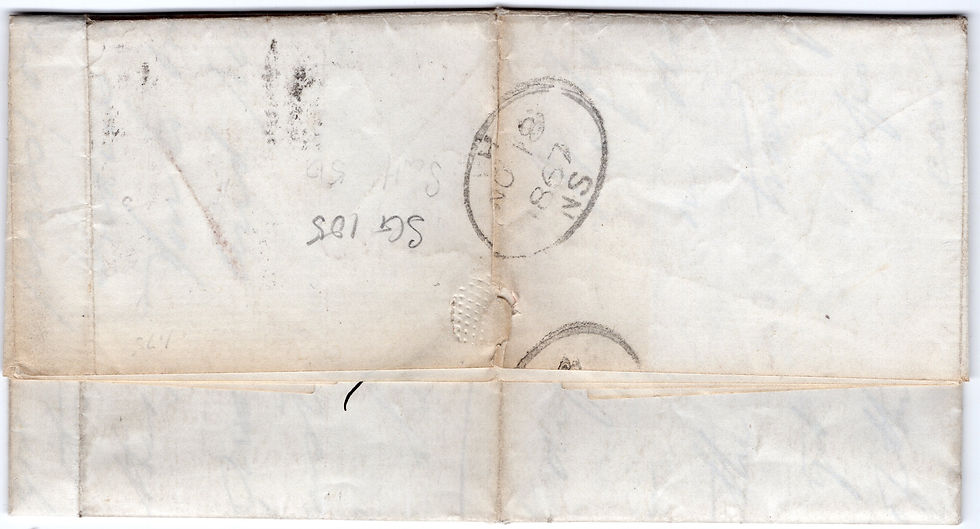

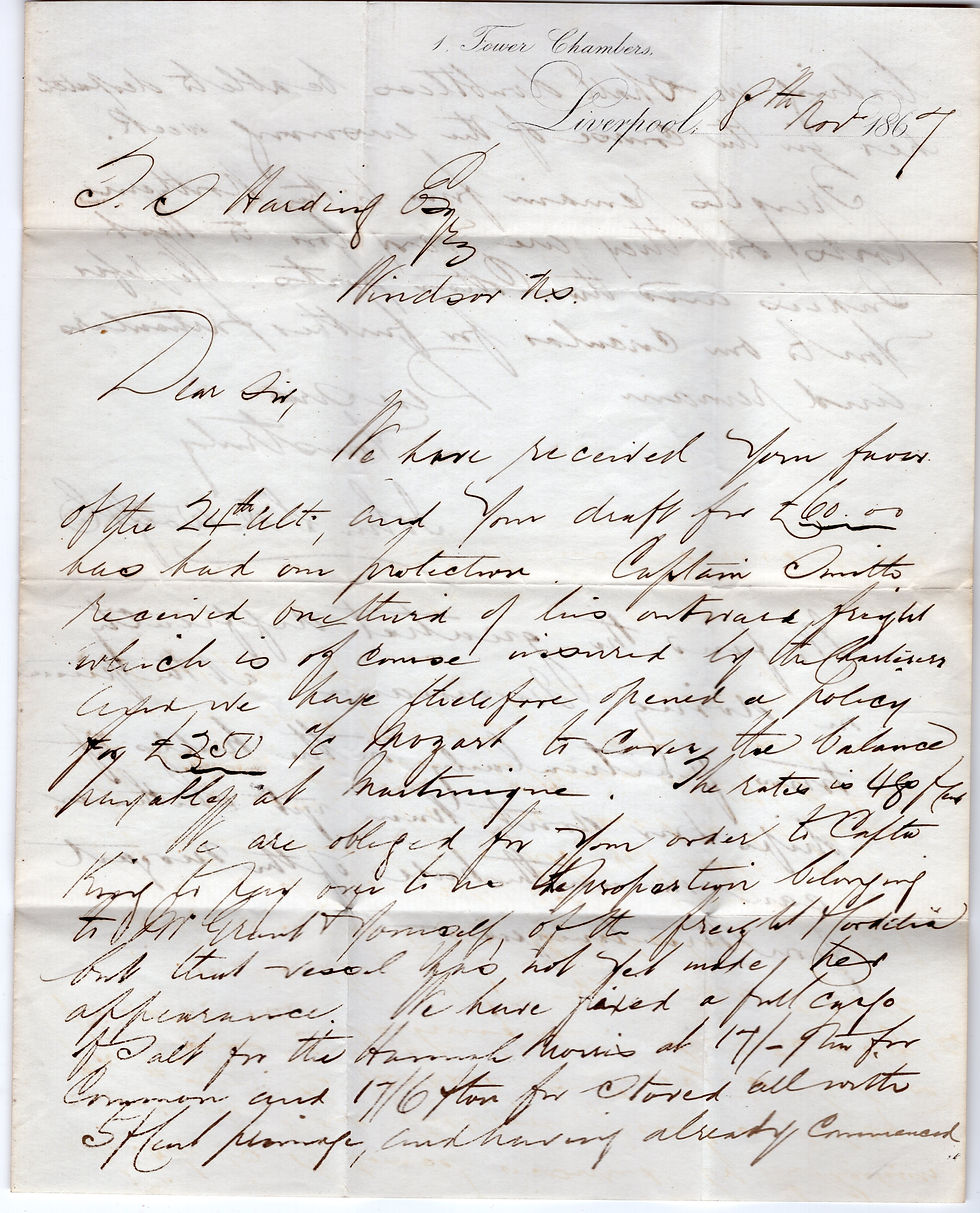

The text of the letter:
One Tower Chambers,
Liverpool, 8th November 1867
T.S. Harding, Esq,
Windsor, N.S.
Dear Sir,
We have received your favor of the 24th ultimate and your draft for £60.00 has had our protection. Captain Smith received 1/3 of his outward freight, which is of course insured by the Charterers. We have therefore opened a policy for £250 at Mozart to cover the balance payable at Martinique. The rate is 48/ton.
We are obliged for your order to captain King two hand over to him the proportion belonging to M Grant and yourself of the freight of Cordelia, but that vessel has not yet made her appearance. We have fixed a full cargo of salt for the Hannah Morris at 17/-/ per ton for common and 17/6 per ton for stored all with St Kitts privilege and having already command loading, we shall doubtless be able to dispatch her in the course of the coming week.
Freights remain firm to the northern parts, but they are very low to West Indies and the Cotton ports. We refer you to our circular for further particulars and remain
Dear sir,
Yours truly,
John S Dewolf & Co.
We find the greatest difficulty in doing insurance at the present time, particularly on the halls of ships we don’t know yet whether we can ensure the halls of the Margaret from Martinique.
The Letter
Unfold the sheet and the story becomes a business one. Written from "1 Tower Chambers, Liverpool," dated 8th November 1867, and signed "John S. DeWolf & Co.", the letter acknowledges receipt of Harding's draft and reports on a marine insurance policy — £250, to cover freight "prepaid at Martinique." The firm discusses the difficulty of insuring ship's hulls at the moment, freight rates holding firm to northern ports but very low to the West Indies, and a cargo of salt being loaded at 17 shillings per ton (common) and 17/6 (stored, with "St Kitts privilege"). It closes with the promise that the ship, once loaded, would "doubtless be able to despatch her in the course of the ensuing week."
It is, on its face, routine shipping correspondence — insurance, freight, cargo — the kind of letter that crossed the Atlantic by the thousand in the 1860s. But both correspondents turn out to be worth knowing.
John S. DeWolf & Co. was a genuine Nova Scotia export success story. John Starr DeWolf was born in Horton Township, Nova Scotia, and went into shipping with his brother James Ratchford DeWolf in the 1830s. By 1840 he had founded J. S. DeWolf & Co. in Liverpool, England, building it into a shipping and insurance firm that ran the Atlantic trade and later a packet route to Australia — most of its vessels built back home in the colonies. Seventeen years into that business, this is a firm well established at the heart of the transatlantic carrying trade.
T. S. Harding, the Windsor recipient, was doing business with exactly the kind of firm a Nova Scotia shipping merchant of the period needed on the other side of the ocean.
T. S. Harding of Windsor
The recipient was Theodore Seth Harding, Jr., born 18 July 1807, son of Theodore Harding (1772-1855) and Zeruiah Fitch (1776-1851). He married three times — to Ann Spurr in 1837 (she died in 1839), to Maria Spurr in 1841 (died 1844), and finally to Susan Nutting Grant by 1845. Several of his children from that last marriage died young and close together, three of them within a matter of weeks in the summer of 1855.
He made his principal home in Windsor, Hants County, where he was "largely engaged in shipping and milling," and was remembered as "an upright and honourable man." His office — T. S. Harding, Shipping Merchant — stood on Water Street, Windsor, in 1867–68: precisely the years of this letter.
Harding didn't just rely on marine insurance from firms like DeWolf & Co. — he'd helped establish it locally. In March 1851 he was one of twelve founding principals of the "Avon Marine Insurance Company" of Windsor. That makes this letter's subject matter — hull insurance, cargo premiums, freight rates — not just routine correspondence but squarely within Harding's own professional territory.
Over the years he owned, in whole or in part, at least seven vessels: Windsor (108 tons, 1849 and 1852), En Avant (119 tons, 1850), Chance (46 tons, 1852), Liverpool (93 tons, 1853) — a nice coincidence given his correspondent's home port — Francis Paul (153 tons, 1854), and the considerably larger Glenalvin (456 tons, 1856).
He also had a hand in the Kerosene Gas Light Company of Windsor (1852), proposing to light the township's streets by underground pipe and overhead lamp, and later partnered in a sawmill and tan bark mill at Panuke Lake. He served 23 years as deacon of the Windsor Baptist Church, and died in Windsor on 24 August 1885, aged 78, buried at Wolfville.
His father, Rev. Theodore Seth Harding — "Father Harding" to generations of Maritime Baptists — was one of Nova Scotia's most celebrated early preachers. He was born in Barrington, Nova Scotia in 1772, the son of Congregationalist New England Planters from Barnstable, Massachusetts, Theodore Seth Harding (1730-1771) and Martha Sears (1737-1823). His father died before his birth. His mother, a pious woman, sought to train up her child "in the nurture and admonition of the Lord."
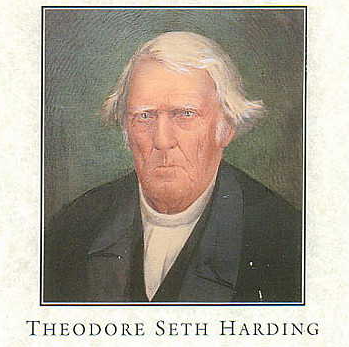
In 1781, Harding was "awakened" under the evangelist Henry Alline. The preacher laid his hands on the head of the orphan boy and said, "may God be a father to him." But Harding ascribed his ultimate conversion to the ministry of Freeborn Garrison, a Wesleyan Methodist from the United States, who visited Nova Scotia in 1787 and afterwards, he derived much benefit from the preaching of Joseph Dimmock. He began to preach as a lay minister in 1793. In the fall of the year he went to Shelburne, and received his credentials as a Methodist minister. While he labored there he had the happiness to witness a revival. In the spring of 1794 he was appointed to Horton, Cornwallis, and Windsor; his preaching attracted much attention, and he was fast rising in popularity.
Harding broke with the Methodists over doctrine. Shortly afterwards he was baptized at Halifax by John Burton. On February 13, 1796, the church gave him a unanimous call to the pastorate. On the 31st July in the same year he was ordained. John Burton, the only other Baptist minister at the time in the province, officiated on the occasion, assisted by deacons Benjamin Kinsman and Peter Bishop. Harding went on to a 58-year career marked by sweeping revivals across the Maritimes and Prince Edward Island before his death in 1854. It's a reminder that the Harding name carried weight in Nova Scotia well before this shipping merchant took up his father's old province — trading the pulpit for the wharf and the insurance ledger instead.
The Ship
The Cuba named on the cover's face wasn't just any steamer — she was one of Cunard's regular Liverpool packets, a running mate to the Russia, Scotia, and Java on the transatlantic mail run. Old travelers nicknamed her the "rolling Cuba" for how she handled in heavy weather — a detail that would prove apt. Built in 1864 by Tod & McGregor of Glasgow. She was an iron-hulled, single-screw vessel of about 2,668 gross tons, approximately 338 feet long and 42 feet beam, and could make roughly 12½ knots. She carried about 160 cabin passengers.

Because two days after this letter went out with her, the Cuba carried a passenger considerably more famous than any Nova Scotia merchant's business correspondence: Charles Dickens, departing Liverpool on November 2nd for his celebrated second American reading tour.
Caroline Ticknor — granddaughter of Dickens's American publisher — left a vivid account of the Cuba's arrival in Boston in her 1922 memoir Glimpses of Authors. A trio of Boston publishers went out on a customs tug, the Hamblin, hoping to spirit Dickens away before the crowds gathered. The Cuba* was late; the search party went ashore at Hull to check the signal station, then took refuge over supper aboard another docked liner while they waited out the cold. When the Cuba finally came in sight, her captain failed to notice the tug's signals, and the little Hamblin chased her wake — until, by sheer luck, the Cuba ran aground on a mud-bank and sat fast for several hours, giving the tug time to come alongside. Dickens, Ticknor writes, was found "peering over the rail ready to greet them cheerily." He landed at Long Wharf on the evening of November 19, 1867, and was taken directly to the Parker House to begin the tour.
So this letter — full of the unglamorous business of hull insurance and salt cargo — rode across the Atlantic in the same week, on the same vessel's rotation, as one of the nineteenth century's most famous literary crossings. It's a nice reminder of what postal history actually preserves: not just the famous voyages, but the ordinary freight-and-insurance business that filled a Cunard liner's mailbags on any given November crossing — DeWolf's letter to Harding just happens to have survived alongside them.
---
Source note: the Dickens anecdote is drawn from Caroline Ticknor, Glimpses of Authors (Houghton Mifflin, 1922), Chapter I, "Dickens in Boston" — public domain and freely available via the Internet Archive.


Comments