
Luke Harrison, bachelor farmer
- Apr 12
- 4 min read


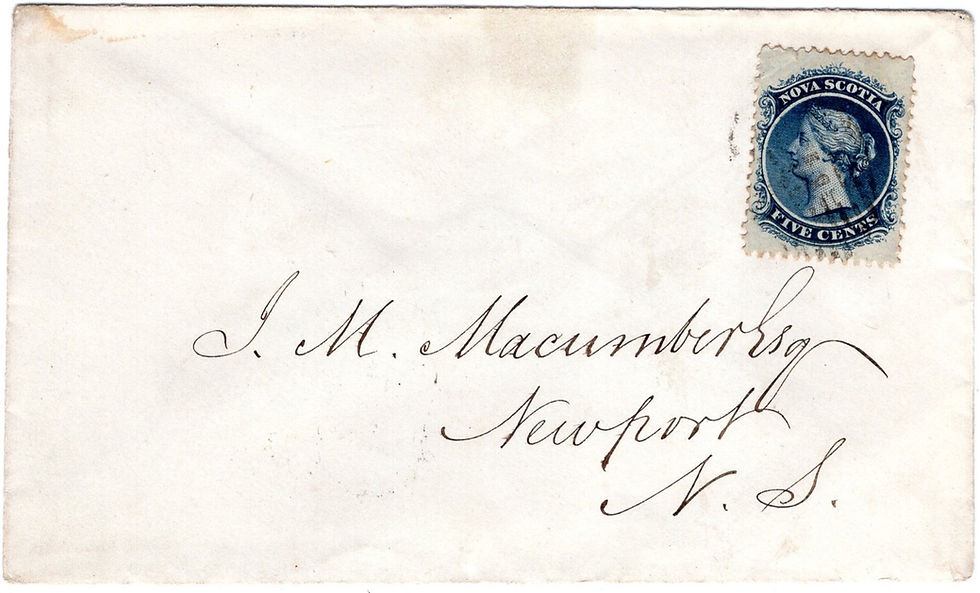
Luke Harrison was a 49-year-old unmarried farmer in Lower Maccan when he received this letter from Halifax in 1866.
Luke Harrison was born February 11,1817 in Maccan, Cumberland County, Nova Scotia the son of William Harrison (1770-1831) and Jane Coates (1779-1853). Luke's father, William had been born in Yorkshire and immigrated to Nova Scotia with his parents in 1774 when he was as four years old.
Hutchinson's Nova Scotia Directory 1864-65 has six Harrison households in Maccan:
Harrison Henry, farmer.
Harrison John L., farmer.
Harrison Thomas, farmer.
Harrison Tillott, farmer.
Harrison William, sea captain.
Harrison William T., farmer.
Hutchinson's Nova Scotia Directory, 1866-67 for Maccan has Harrison John L, farmer, along with four other Harrison farming families: Henry, Thomas, Tillott, and William T.
Luke Harrison died October 26,1868, aged 52 years, he is buried in the Maccan United Baptist Church Cemetery. His gravestone is marked with an upward pointing hand and the inscription "Yonder is my home."
Luke's grandfather, John Harrison was born 20 Jul 1718 in Low Moor, Rillington, Yorkshire England. John Harrison, farmer, with his wife and 9 children (one of which was William Harrison, Luke's father), left England the week of 5th to 12th of April 1774, from the Port of Scarborough bound for Nova Scotia. The reason for emigrating is stated as "forced to leave the Kingdom being over rented in his Farm."
The Harrisons were part of the Yorkshire Emigration.
Nova Scotia's Lieutenant Governor Michael Francklin and other military men had acquired large land grants following the expulsion of the Acadians. On November 13, 1764, the Nova Scotia government gave to J.F. Wallet-DesBarres vast lands in the Chignecto Bay area of Cumberland County: 8000 acres at Menoudie, 8000 at Nappan and Maccan, and 20,000 at Tatamagouche and 20,000 at Memramcook. Some displaced Acadians were permitted to settle these lands as tenants.
In 1771 Lt. Governor Michael Franklin travelled to northern England to seek immigrants. He was looking for skilled farmers who could take up lands formerly cultivated by the displaced Acadian minority, and who could counterbalance growing republican sentiment within both Nova Scotia and the Colonies to the south. For five years, until the British Government began to grow alarmed at the scale of emigration to North America, agents actively recruited settlers in Yorkshire.
The first of these Yorkshire emigrants arrived in 1772 aboard the Duke of York. This vessel departed Liverpool on March 16, 1772 with sixty-two passengers, and reached Fort Cumberland on May 21, 1772. During 1773-1775 additional vessels left for Nova Scotia, the largest number arriving during the spring of 1774, when nine ships carried settlers from England to Halifax.
In all, more than one thousand people emigrated from Yorkshire and Northumberland to Nova Scotia (including parts of what later became New Brunswick) between 1771 and 1776. As a group, they comprise 'The Yorkshire Emigration', a significant event in the history of the Maritime provinces. The settlers shared a common language and dialect, a pioneering spirit and — as the years passed — strong bonds created by intermarriage. Many were Methodists, and instrumental in the establishment of the Methodist Church in Canada. Almost all remained loyal to Britain during the Eddy Rebellion, thus helping to determine the future of both Nova Scotia and the future nation of Canada.
For the first several years in Nova Scotia, the Harrisons leased a farm on the River Hebert from Lt. Michael Francklin. John and Sarah's son Luke wrote letters to his country back home complaining bitterly of the place, especially the mosquitoes. Years later, Luke completely changed his view, declaring he'd much rather stay in Nova Scotia than return to England.
According to a note in the DesBarres papers, "About the year 1781, Harrison went on the farm he now occupies." At the time the property contained about "30 acres of old French clearing" and 8-10 acres of stumped land in addition to 3 small dwellings that DesBarres had built for the French. The orchard was producing 300-400 bushels of apples. (DesBarres Fonds online, Series 5 M.G. 23, vols. 19-20, Doc #4072 Reel C-1459, image 443).
On 1 July 1784, John Harrison leased the 750-acre property, then in the possession of John Harrison and his son-in-law Matthew Lodge. (DesBarres Papers, Series 5, M.G. 23, F 1-5 Vol. 18 Document #3474, Reel C-1458 Image 972). Ten years later, when agent Captain John MacDonald visited DesBarres's properties in Maccan, he reported that Harrison “is thriving—the father-in-law of Matthew Lodge in your list, who having bought a farm elsewhere for himself has left this one, for which he stands in your list, to his father-in-law.”
John Harrison left the homestead on the lower Maccan to his wife Sarah for her lifetime and then to his youngest son William, Luke Harrison's father, following her death. John's estate inventory included more livestock than the family would have needed for subsistence, 18 tons of English hay and 18 tons of marsh hay, crops of grain, turnips, potatoes, apples, and cheese and butter. (Nova Scotia Probate Records 1760-1993, Estate Files 1764-1938, no. 919-965 (H), #924, image 154). Harrison descendants later acquired several 100-acre properties adjoining the original homestead, some of which extended all the way west to the boundary with Francklin.


Comments