
Maximin Forest, Acadian Marchant
- 12 minutes ago
- 9 min read


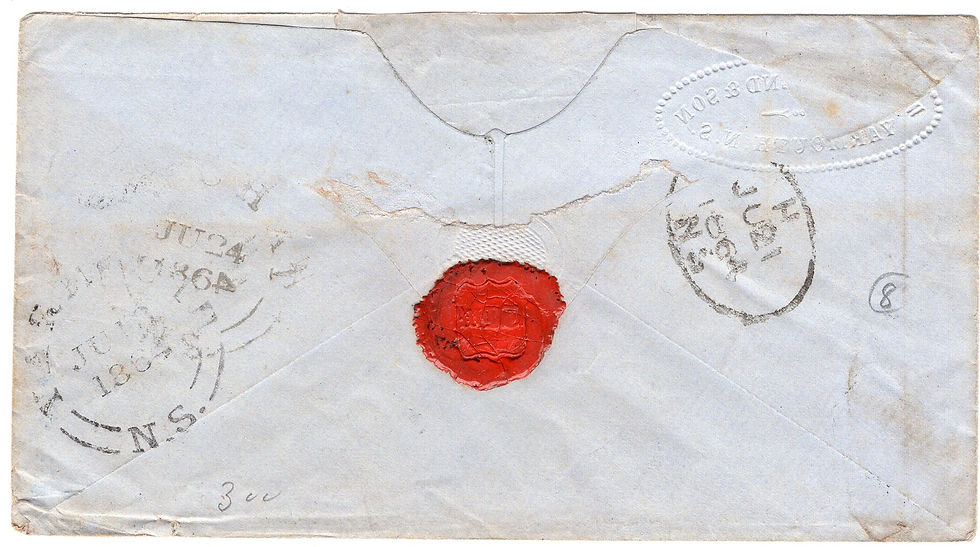
Maximin Forest was a commission merchant in Arichat, Richmond County, Nova Scotia when he received these letters from Halifax in 1862 and 1864.
The 1871 census, of Petit de Grat, Richmond, Nova Scotia has Maximin Forest. 40, Roman Catholic merchant with his wife Caroline Forest, 47, daughter Martha Forest, 11, and Michael Forest, 60
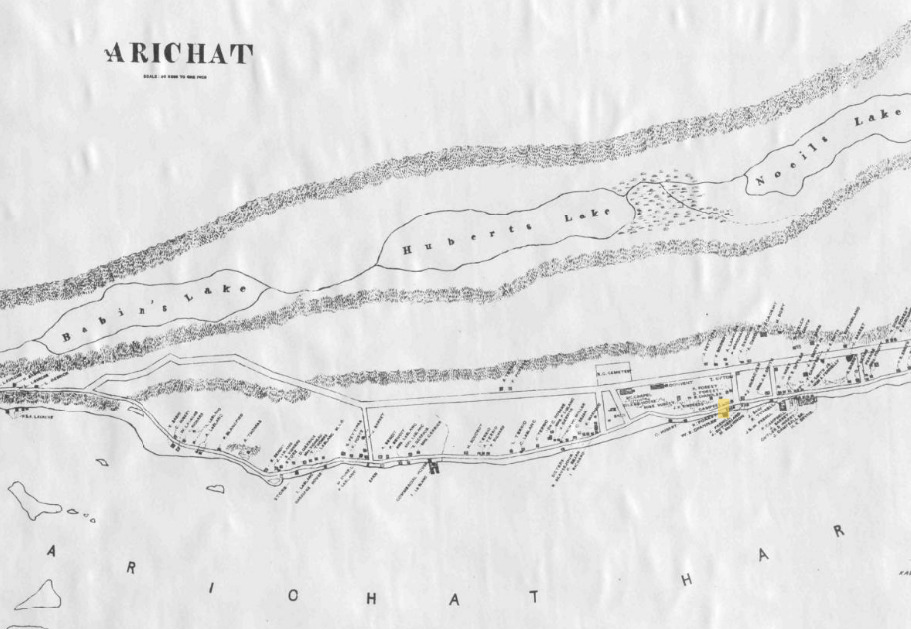
Maximin was the grandson of Maximian Foret an Acadian refugee born in exile.
In 1755, about forty months before the elder Maximian's birth, the British began the Acadian expulsion and imprisoned 2000 (nearly half) of the Acadiens from their provincial homeland, including Maximain's parents, older siblings and grandparents, Pierre and Madeleine Babin. On October 13, 1755, the family was among the 1066 people imprisoned in Fort Edward in Pisiquit before being sent to the small colony of Weymouth, Massachusetts on October 20, 1755 with 920 other Acadians.
On February 25, 1758 Maximian Forest was born in exile in Weymouth, Norfolk, Massachusetts and, on August 14, 1763, Maximain's family (his parents Simon Forest and Marguerite, 6 sons and 1 daughter) were recorded in the general list of Acadian families held at New England.
On August 24, 1763, Andrew Oliver (colonial administrator in the Province of Massachusetts Bay) wrote a letter to Jasper Mauduit (agent in London of the Province of Massachusetts Bay), about the high cost of keeping the prisoners and that it would be better to "not pay for enemies." Oliver wrote:
"these French People have received an invitation from Mr. (Charles) Robin, a French Protestant who hath obtained a grant from the Crown of a tract of land lying on the Bay or River Merrimeche, (Miramichi) in the Gulf of St. Lawrence, to settle on the said Grant. Some of them may probably embrace this offer. They seem generally inclined to remove out of the Province. If this should be (the) case and we lose the benefits of their service now they might be made useful subjects; after that we have been at the charge of supporting them while they were looked upon as Enemies, the Province hath an equitable claim to a reimbursement (from the French king) at all Events."
In this letter, Oliver listed French heads of families in exile who wished to return to 'Old France' including Maximain's father Simon and his widowed grandmother.
In the fall of 1763, Maximian's family, along with other Acadian exiles, was permitted by the British authorities to return to Nova Scotia. However, a significant condition of their return was that they were barred from reclaiming their former lands, as these had been confiscated and granted to English settlers in their absence. Maximian's father, Simon Forest, joined with other Acadian families in establishing the community of Arichat in the Cape Breton Colony.
As Maximian had been born in exile, he needed to be baptized. There was no Catholic parish on the island then, so Father Charles François Bailly traveled the island and recorded everything in his journals. On July 28, 1771, in Caraquet, 13-year-old Maximin was baptized, and his godparents were Jean Landry and Marguerite Bourg. His siblings Simeon, Ignace, Marguerite, Maximin, Pail, Pierre were also baptised.
In 1780, Maximian married Clothilde Scholastique LeBlanc, daughter of Rene LeBlanc and Anne Blanchard. There was still no parish, so it was recorded in Father François Lejamtel's journals and in their son Charle's marriage record. They had six children before Scholastique died at 38.
Their children, all born in Arichat, were:
Angelique FOREST1785
Charles FOREST, b. ca 1786
Polycarpe FOREST, b. ca 1787
Barbe FOREST, b. ca 1793
Paul FOREST, b. ca 1796
Maximien FOREST, b. after 1797
Sabine FOREST, b. ca 1800
Olive FOREST, b 1801
On March 8, 1786, Maximian Forrest was one of the seventy heads of families (including his father, Simon Forrest, brothers Simon Forrest Junior, Jean Forrest, Hilarion Forrest, Firmin Forrest and father-in-law, Rene Leblanc), who founded Arichat Parish that wrote to the lieutenant governor of Cape Breton, J.F.W. DesBarres for land for a church and school, protections and tax exemption, which they received.
In 1787, Maximian was already defending the land his family had built up since their return from exile. That year, Father William Phelan, the newly arrived Catholic priest at Arichat, obtained a "licence of occupation" from the Sydney administration for a piece of land on Arichat Harbour that Maximin and his father Simon had already been occupying and improving for 23 years. Phelan had "thrown down and destroyed the Fish Flakes which the said Maximum Forrau [sic] had prepared for curing the Fish to be caught by him during the ensuing Season." Maximian filed a formal complaint with the Governor's Council in May 1787. The initial report from the local justices was dismissed for "informality and apparent partiality," but after a second examination by Mr. Murphy, the Council ruled partially in Maximian's favor on 15 March 1788, awarding him the front two acres of the disputed land while Phelan received the remaining 78 acres in the rear. This arrangement, born of conflict, is the same one Maximian described in his 1808 petition twenty years later, when he wrote that he was told by the Governor "he had no occasion to apply for a Grant, as his place would be considered as a fishing Lot."
The conflict with Phelan did not end with the 1788 Council ruling. Over the following four years, the priest's conduct created escalating tensions with the Arichat community. Phelan was operating a commercial store, selling salt at 100 percent profit, and had obtained land grants on property where 17 French families already lived. The parishioners had nicknamed him "prêtre bourgeois" for his mercantile activities. Father Jones, the Superior of Missions, received complaints about Phelan's "secular pursuits and reprehensible transactions," including participation in exploitation of the Mi'kmaq in his mission. In April 1792, Jones travelled to Arichat to remove Phelan from his position. In response, the Catholic community of Arichat organized a formal petition to the Council supporting Jones's actions. That petition was "presented to the Council by one of the Forets, and signed by 111 Roman Catholic families of the Arichat district." Given Maximian's earlier conflict with Phelan over the fishing lot, and the organizing role his family played in Arichat affairs, it is likely he or his father Simon was the petitioner. The effort succeeded. On 27 September 1792, Jones returned to Arichat with Father François LeJamtel, a French priest who had fled St. Pierre after refusing to take a revolutionary oath, and installed him in the parish. LeJamtel would become the family's priest for the next decade, recording the baptisms, marriages, and tithes referenced elsewhere in this document. [6]
In 1788, his father and brothers bought 8 lots together on the Arichat waterfront. The document translates as:
By His Honor William Macarmick, Lieutenant Governor of the Island of Cape Breton and Its Dependencies
To Patrick Rooney, Nugent Esqr.
You are hereby directed and required to survey and lay out unto Simon Forest Senior, John Forrest, Lorion Forrist, Simon Forrest Junr., Peter Forrest, Paul Forrest, Romain Forrest, the following Lots of Land in the Town and Harbour of Conway or Arichat on the Island of Richmond or Madame: Lot 18 admeasuring five chains in front. Lots 21 & 22 admeasuring ten chains. No. 23 admeasuring five chains 19 [links]. Lots 24 & 25 admeasuring ten chains thirty six links in front. Lots No. 31 & 32 admeasuring five chains ninety links in front, which said several lots are to carry the same admeasurement of front back to the extent of Eighty Chains. And you will report the same as soon as possible in order that a Grant may pass to the above mentioned Persons for the same, for which this shall be your Warrant.
Given under my hand and seal this 14th day of February in the 28th Year of His Majesty's Reign.
By Command of His Honor — W. Macarmick
Conway was an alternative name proposed for Arichat that never stuck, and Richmond was the proposed name for Île Madame. Neither name took hold in common use, but both appear in official British documents of this period. The land is close to what is now the LeNoir Forge Museum, a collection of some of the oldest stone buildings on Cape Breton Island, built during the same period between 1780 and 1800. The land is close to what is now the LeNoir Forge Museum, a collection of some of the oldest stone buildings on Cape Breton Island built during the same time between 1780 and 1800.
In 1791, Maximian 'Furry' occupied a lot between the Chapel and Mr. Clement Hubert's property. Fortunately for later historians, in 1837 the ship H.M.S. Pique became icebound off Arichat. Its captain and his wife, Caroline Bucknall Estcourt, painted watercolours of the area. In three of their paintings you can see the chapel, and in one you can see the present Catholic Church and a large building that appears to be the Clement Hubert house. The chapel stood on a water lot where the cannons are now located on Veterans Memorial Drive, which is also where Maximian's lot would have been.
Father François Lejamtel noted in his journal that Maximian had paid tithes every year from 1796-1801. Also according to Lejamtel's journals, on April 16, 1800 (three days after Easter) in Arichat, it was time to start the hunt for "sea wolves" and Maximian Forest sponsored a high mass for the smooth running of the operation.
In 1805 Father Lejamtel recorded Scholastique’s funeral (October 19, 1802) and Maximian’s upcoming marriage to Angelique LeBlanc, daughter of Joseph LeBlanc and Francoise Dugas and widow of Piere Bernard Loubert.
In 1808, Maximian petitioned for (and was granted) the land he had been living on. The memorial reads:
The Memorial of Maxamain Furry
Humbly sheweth
That your Memorialist is an old Inhabitant of Arichat, and for Twenty Years occupied a lot of Four acres between the Chappel and Mr. Clement Hubert's which he intirely cleared and made considerable improvements thereon, Say a good House clapboarded and covered with Shingles, and some out Houses for Cattle.
That in consequence of the late Revd. Mr. William Phelan obtaining a Grant for the land in the rear of your Memorialist's lot, he was told by the Governor (at that time) he had no occasion to apply for a Grant, as his place would be considered as a fishing Lot, relying on that promise has made no farther application.
That your Memorialist having a numerous Family of fifteen Children, and the place he occupied to ma[ke] to support them he purchased from an Inhabitant (Peter LeBay) a lot at Arichat, where he removed to, with his Fami[ly] and rented his place near the Chappel to a Louis Heuro, late of Sydney, for about ten or eleven Months and in February 1807, Your Memorialist sold it to the said Huro and promised to give him a Title, when the consideration money for it was paid. But your Memorialist to his great astonishment has been lately informed that the said Huro has applied for the place in his own name. :Therefore your Memorialist most humbly prays Your Honor will take his case int consideration, to prevent the said Louis Heuro from taking so unfair an advantage to the great Predudice of your Memorialist, and that Your Honor will be pleased to grant your Memorialist a Crown Lease, as soon as he can send a plan of the premises.
And your Memorialist as in duty bound will ever pray.
Maxamin Furry X
Arichat 17th April 1808
In the 1811 Nova Scotia Census, Maximian Forêt appears as one of the most substantial householders in Arichat. He was recorded as a mariner leading a household of 26 people: 5 males aged 14 to 60, 2 females aged 14 to 60, 12 unmarried males and females, 3 males under 14, and 4 females under 14. His property included 4 cattle, 1 horse, and 2 vessels. This was an extended household that almost certainly included his own children, other relatives, and workers connected to his maritime operations. Only the parish priest, Revd Francis LeJametel, headed a household of comparable standing. Nine other Forêt households appeared in the Arichat census that year, two of them explicitly identified as Maximin's sons (Ignatius and Policarp), establishing the Forêt family as one of the dominant Acadian networks in the community.
In 1815, "Foret, Maxmillan" was granted a water lot in Arichat. The petition to Swayne records: "Petitioner has purchased a lot at Arichat Harbour leased to Peter Landris Labey in 1804. He asks a water lot in the front of his orchard." The note reads: recommended.
Maximian owned two the schooners:
Prudent, which his son-in-law, George Sivret, captained.
Olive, which George Sivret also captained. This schooner was named after his youngest daughter, Olive, who went to live with his eldest daughter, Angelique and her new husband, George Sivret, after the death of Maximian's wife.
In the 1838 Nova Scotia Census, Maximain Foret is recorded as just him and his wife, Angelique in the house but 4 total in the family.
Maximian died on February 28, 1840 (noted in the burial record as the day before the leap day) at Arichat, Cape Breton Colony (now Nova Scotia) and was buried there on March 1.


Comments