
Robert Foreman, Merchant and Way Office Keeper
- Jan 13
- 8 min read
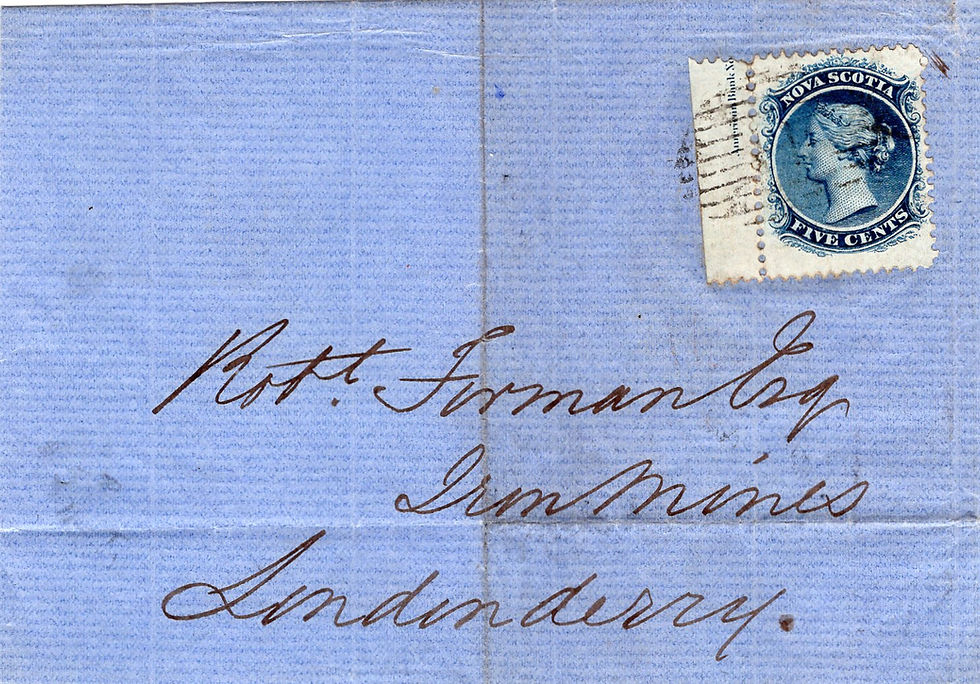

Robert Forman was a 37-year old merchant, ship owner, and way office keeper in Acadia Mines when he received this letter in 1865 from Thompson Abbott & Co. of Halifax. He was born in 1827, in Halifax, Nova Scotia, Canada, the son of James Forman and Margaret Ann Richardson. He married Louisa Tremain on 28 October 1857, in Charlestown, Boston, Massachusetts. They had one son. After Louisa died, Robert remarried in 1862 Marion Steel of Amherst. They had four sons and three daughters. Robert died on 12 June 1883, at the age of 56, and was buried in Camp Hill Cemetery in Halifax.
On October 28, 1857 in Boston, Robert Forman, 30, merchant, of Halifax born Halifax, of James and Margaret A. Forman, married Louisa Tremain, 23, of Charlestown, born Halifax, of Charles W. and Louisa B. Tremain.
In 1861 census for Colchester County Robert Forman is head of a household of 5, 2 males and 3 females with 1 male under the age of 1.
On July 31, 1862, Robert Forman, of Acadia Mines, merchant, widower, married Marion Steel of Amherst, spinster, at Amherst Presbyterian Church.
Robert Forman, merchant of Londonderry, was owner of the brigantine Adrio, built 1864, registered Halifax, crew of 4, 8 shares, and owner of the schooner Bedford, built 1864, registered Halifax, crew 1, shares 64.
McAlpine’s Nova Scotia Directory, 1868-1869, for Acadia Mines, lists Robert Forman, trader and way office keeper.
1871 census Londonderry, lists Robert Forman, 43, Presbyterian, merchant, born NS, with his wife, Marion, 36, and children James, 10, Robert, 8, Henry, 6, William, 4, Margaret, 2, Marion 10 months, and his widowed uncle, Henry Stanford Blankley Foreman, 60, physician.
The 1881 census for Middle Londonderry lists Robert Forman, 53, Marion Forman, 46, James Forman, 20, Robert Forman, 17, Harry Forman, 16, William Forman, 14, Margaret A. Forman, 12, Marion Forman, 10, Walter Forman, 9, and Mary E. Forman, 8
Robert's grandfather, James Pringle Forman, was born December 21, 1763 in Coldstream, Berwickshire, Scotland. He immigrated to Halifax in 1789 and married Mary Gardner Newell in 1791. Robert's father, James Forman, a Halifax merchant and banker, was accused of embezzlement in the late 1860's. He was born in May 1795 at Halifax, N.S., the eldest son of James and Mary. James Forman was probably educated at the Halifax grammar school. His father was a successful merchant in partnership with George Grassie, and it is likely that James was trained in the family business and worked with the Grassie family after his father’s retirement in 1820. On March 5, 1821 Forman married Margaret Ann Richardson at St Matthew’s Church, Halifax. James and Margaret had two sons - James Richardson Forman and Robert.
James Forman was one of the men who petitioned the Nova Scotia assembly on January 31, 1832 requesting incorporation of the Bank of Nova Scotia. The incorporation was granted on 30 March, and William Lawson became the bank’s first president. On 24 May the bank appointed James Forman its first cashier – a position equivalent to general manager. After a period at the Bank of New Brunswick in Saint John, where he studied its accounting system, Forman took up his new duties. When Forman’s friend, Mather Byles Almon, succeeded Lawson in March 1837, the cashier was placed in a position of great trust which he maintained throughout Almon’s 30-year presidency. During these years Forman was active in the community as a member of the Nova Scotia Literary and Scientific Society, treasurer of the Halifax Mechanics’ Institute, a trustee for the Provincial Building Society, a member of the council of the Horticultural Association and International Show Society, and president of the North British Society of Halifax.
Although the Bank of Nova Scotia opened several new branches during Almon’s presidency and Forman’s tenure as cashier, its annual statements showed little progress. A partial explanation for this lack of success came to light in 1870 with the discovery by the accountant, J. C. Mackintosh, that over a period of many years James Forman had embezzled about half the bank’s capital of £140,000 – a theft of $314,967.68. After his actions came to light, Forman transferred property worth $179,296.45 to the bank as partial coverage for the theft. Because of Forman’s social position and the collapse of his health, the bank did not prosecute, despite an uproar in the local press. A rumour at the time said Forman had taken the money to help his son who was in financial difficulty, and this supposedly brought public opinion to Forman’s side. He quickly left Halifax and went to London where he died a few months later, probably early in 1871.
Thompson, Abbott & Co.
The letter's sender, Thompson, Abbott & Co. were commission merchants in Halifax.
Hutchinson's Nova Scotia Directory, 1864-65 lists Thompson, Abbott & Co. Commission Merchants, 81 Upper Water. Halifax
Cathcart Thomson was born 24 May 1828 in Hanover Parish, County of Cornwall, Jamaica. His family moved to Nova Scotia some time after his father died in 1829. On 22 Oct 1851 he married Ellen Howe. They lived in Annapolis, Nova Scotia until about 1855.
Cathcart was an importer/trader in Halifax heading the firm Thomson, Abbott & Co. In 1862, he joined the newly founded Halifax Club, as did his partner Thomas Abbott, his brother James and many others. The partnership with Abbott dissolved about 1876 and Cathcart carried on his own as a commission merchant until 1892. Cathcart Thomson Co. owned (1867 to 1868) the barque Glacier, which sailed the North Atlantic and West Indies. He was Vice-President of the Ocean Marine Insurance Association by 1870. From 1877 to 1882, Cathcart alone was listed as a Commission merchant at 111 Upper Water. The 1882-83 listing places him at 96-98 Upper Water. He continued there to 1887-88 and was also listed as a tea dealer in 1886-87. In 1888-89, Cathcart is listed as a Commission Merchant and also from 1889-90 to 1892-93. Cathcart patented a “Mode of Drying Fish” which would produce bales of fish. Cathcart and Ellen’s house was named Pine Cottage. They lived there from 1869-to 1885. In 1886, he was at 12 South Street next to his brother George. Cathcart lived in the Halifax area until 1895. Cathcart and Ellen went to England and were living in South Chelsea in 1901. They later lived with their daughter Katharine in Killmalic, Kilballiowen, Limerick, Ireland. Cathcart died there 31 December 1909 at 73 years of age. He was buried in the graveyard of St. John's, Knockainey.
Cathart's father, James Thomson was born 13 August 1775 in Boston to James Thomson and Jean Buchanan. A relative by the name of George Buchanan who was living in Jamaica left him an estate called Spital and his business consisting of a quantity of slaves, which he contracted out. In March 1810, James Thomson, proprietor of Spital, had 89 slaves and 4 livestock. He was taxed for his slaves until 1831. The James Thomson household "Spital" was enumerated in 1823 as consisting of James Thomson, Ketty Maria Sharp (abt.1787-) and six Thomson children aged 3 to 17. James married Christian Renny 27 APR 1824 in Halifax, Halifax, Nova Scotia, Canada He was listed in 1824 Jamaica Civil List for Parish of Hanover, Cornwall as an asst. judge or magistrate. James died 2 Jan 1829 in Jamaica. His remains were buried in the Old Cemetery in Halifax, Nova Scotia. In March of 1830 he was still listed as the proprietor of Spittal and 86 slaves. By 1832 his slaves had been sold.
Acadia Iron Mines

In 1844, two loggers discovered iron ore seams near their mill on the Great Village River. The site was visited by world-famous geologists who determined it would be economically viable to mine. A report in the British Parliament on 9 November 1847 noted that “charcoal iron made from these ores will rival the best made in Sweden” with ore consisting of iron levels as high as 70%. Acadia Charcoal Iron Co. began mining operations in 1849 along the bank of the Great Village River, from which grew the settlement of Acadia Mines (also known as Acadian Mines). The mine’s workings included several open quarries, vertical and horizontal shafts – some as deep as 70 feet – a Catalan forge, a 35-foot-high blast furnace, and a large damn to generate power. In 1851, samples of their ore and pig iron were sent overseas for the manufacture of guns. Samples were also sent to the Great Exhibition in London, where they received first prize.
The pig iron the mine produced was transported by ox cart or horse to the nearby town of Great Village (previously known as the Port of Londonderry) and loaded on to ships. Once the railway was complete in 1858, ore was also shipped by train to Halifax. In 1869, the mine began manufacturing steel car wheels for the anticipated Intercolonial railway and produced steel used for drilling during its construction. When the Intercolonial railway line from Truro to Amherst opened in 1873, Acadia Mines prospered. In 1874, the mine was purchased by the Steel Company of Canada, who, over the next ten years, spent $2.5 million on expansion including adding a 63-foot-high blast furnace. In 1875, the mine established a second operation at East Mines. Population in the Acadia Mines settlement increased by 130 percent over the next ten years. It is estimated that during its peak, approximately 1200 workers were employed at the mine.
1876 was an exciting year for the mining operations as 67 experimental beehive-shaped coke ovens were added to the site to produce coke from coal. Tracks were laid across the top of the ovens, and small coal cars filled each oven through its “charging hole” on top. It took over 40 hours to produce coke from coal. By 1906, the mine had a total of 53 beehive ovens.
Water was very important to mining operations including both the blast furnace and coal wash. The Rockland River was damned to create a reservoir, from which a flume channelled water to the blast furnace. The edge of the river was also where white-hot slag was dumped. It was said that at night, the glow of the hot slag could be seen all the way down the Cobequid Bay.
As the mine’s operations expanded, it began to manufacture several new products. A wire mill that produced fencing was added in 1887, and in 1888, a pipe foundry was constructed. Around this time, the company reorganized and was renamed the Londonderry Iron and Steel Co. Ltd. Historian Trueman Matheron noted that the company was “the only iron works in Canada with smelting, casting, and rolling, all under the same management.” The company’s prosperity did not last long, however. By 1891, the iron ore was nearly exhausted, and the mine could no longer run the blast furnace. The company began to outsource ore form Torbrook, Annapolis County, but their ore contained too much phosphorous and produced low-quality iron by comparison. This impacted Londonderry’s reputation for producing high-quality iron. Between their damaged reputation and the competitive price of imported iron, in 1898, the mine ceased operations. This did not discourage some investors, however, who reopened the mine in 1903, renaming it the Londonderry Iron and Mining Co. Everything except for the rolling mills resumed operations. The town also had a new name, which officially became Londonderry in 1902.
Unfortunately, Londonderry’s rejuvenated mining operations were short-lived. In 1908, operations ceased for a second and final time. The effects of the mine’s closure were felt throughout Colchester County and even the province. The town of Londonderry was the hardest hit as mine workers and their families moved away. In 1920, disaster struck: on a dry and windy spring day, a raging fire destroyed 54 buildings in the town. During its peak in the 1880s, Londonderry was a community of 5000 people. After the fire, the population decreased dramatically, eventually becoming a ghost town. The mine’s iron works were sold for scrap in the 1920s and the rest was purchased and dismantled over the years. All that remains of Acadia Mines are some bricks from the coke ovens and the remnants of the “slag pit” by the Rockland River. Ashley Sutherland, “Acadia Mines,” Historic Nova Scotia https://historicnovascotia.ca/items/show/114.


Comments