
Fanny Foster, farmers daughter
Updated: Aug 16


A farmer’s daughter, away from home
Francis Lovinia “Fanny” Foster was born May 25, 1853, in Aylesford Township, the fifth of ten children of Ezra Foster (1816–1903) and Annie Nancy Spinney (1823–1910). When this letter reached her in March 1867, not yet fourteen, she was apparently not living on the family farm — the address care of “B. Kinsman” suggests she was working in or around Kinsman’s store or household, whether as a shop hand or domestic servant, a common arrangement for a farm family’s daughter old enough to earn a small wage away from home but still young enough to need a trusted household to board with.
Kinsmans Corner:
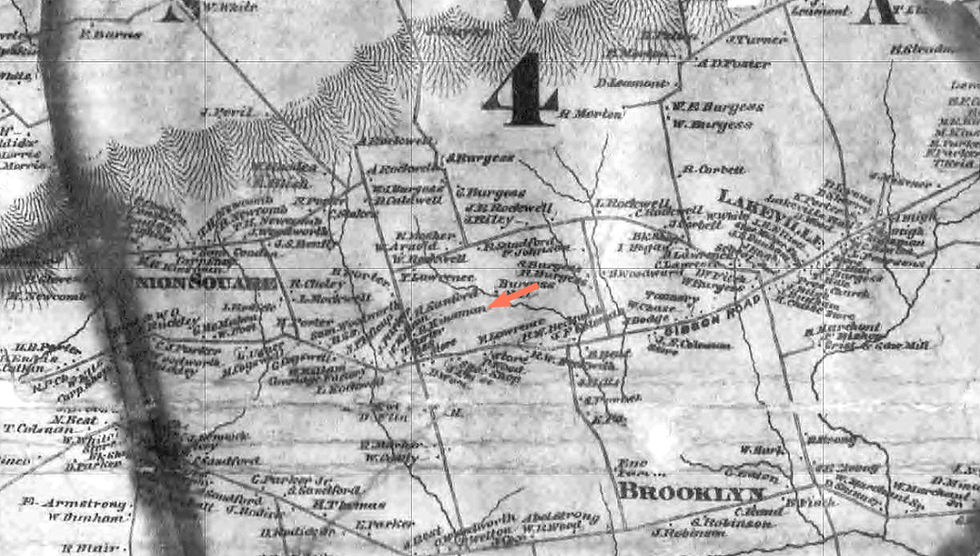
The address places her at what was, at the time, still known as Kinsmans Corner — the community’s name before local residents voted in 1864 to rename it Woodville, in honour of early settler Samuel Wood. The Kinsman family store stood at the center of this renaming decision: citizens met there specifically to choose the new name, when Nova Scotia’s 1864 public school legislation required every school section to be formally named. A post office would not be established in the store itself until 1871 — four years after this letter was sent — so in 1867 mail for anyone at Kinsmans Corner still had to route through the nearest post towns, Kentville and Aylesford, exactly as this cover’s backstamps show. The Kinsman family’s roots in the township ran deep: an original Planter grantee named Benjamin Kinsman received a 300-acre lot in Cornwallis Township in the 1760s, and his descendants were still keeping store and giving the crossroads its name a century later — very likely the same family, and quite possibly close kin, to the Marshall Kinsman of nearby Lakeville who appears in a separate letter and post in this collection. The 1871 census for Lakeville records a Ben Kinsman, 49, “Free Thinker,” merchant, with his wife Elizabeth, 45, “Christian,” and three children — the religious mismatch recorded for husband and wife a small, human detail from the census taker’s own hand.
Marriage, and a census puzzle
Two and a half years after this letter, on November 3, 1869, Francis Lovinia Foster, 18, daughter of Ezra, married William Wood, 21, son of Daniel Wood (1819–1899) and Sarah Brown (1829–1916), at Berwick Baptist Church. William was himself a farmer. The 1871 census, taken not two years later, oddly still lists a “Lovinia Foster, 20” in her parents’ household in Aylesford, alongside Ezra, Anna, and their nine other children — almost certainly a simple case of the census enumerator working from an outdated household list and failing to note that this particular daughter had since married and moved out, rather than any real ambiguity about her status. The same 1871 census correctly records her, under her married name, in Harbourville: William Wood, 22, Baptist farmer, with wife Frances Wood, 20, and infant daughter Florence Wood, 7 months.
By the 1881 census, the family had settled in Centreville, Kings County: William Wood, 33, Baptist farmer, with Fanny, 28, and children Florence, 10, and George, 3 (recorded in the original as “Gorge”). Fanny and William went on to have three sons and two daughters in all — meaning at least two more children arrived after this 1881 snapshot. Fanny died April 17, 1943, in Centreville, and is buried in Lakeview Cemetery, Billtown, Kings County — the same cemetery, fittingly, at the heart of the same small cluster of Kings County farming communities where she had spent her entire life, from a teenage girl boarding at Kinsmans Corner to a farmer’s wife and, eventually, a great-grandmother of the district.


Comments