
Samuel Strong, A Merchant, Six Covers, and a Web of Connections
Updated: 6 minutes ago
Postal covers are often treated as the frame around a letter, the letter itself is assumed to contain the history. In the case of Samuel Strong of Halifax, many of the letters have disappeared, but the covers have survived. Six of them—spanning 1859 to 1863—are enough to open a surprisingly wide window onto his life and business. They lead from Liverpool, Nova Scotia, to Bradford, England, to Lisburn, Ireland, to Glasgow, Scotland and to London, and connect with the transatlantic mail system used by British manufacturers and Halifax merchants. They also introduce a cast of people whose own lives illuminate the communities and commercial networks in which Strong operated.
The six covers do not tell us everything. Most have lost their original letter contents. It would be wrong to invent transactions or conversations that cannot be recovered. What the covers preserve is often just as valuable: names, places, dates, postage rates, postal routes, business addresses, and the identities of the people who maintained the correspondence. When those clues are tested against directories, census records, newspapers, shipping records and later biographical sources, the covers become much more than postal artifacts.
The six covers
Date | Origin | Destination / sender | Philatelic clue |
1859 | Liverpool, N.S. | W. S. Jacobs → Samuel Strong | Nova Scotia 3d blue pence issue |
1860 | Liverpool, N.S. | J. R. Hall → Samuel Strong | Nova Scotia 5¢ decimal issue |
1861 | Bradford, Yorkshire | Shaw Har. → Samuel Strong | Great Britain 6d lilac; Liverpool transit |
1862 | Lisburn, Ulster, Ireland | Wm. Barbour & Sons → Samuel Strong | Great Britain 6d lilac; Lisburn “304”; Lisburn MR 8; Halifax MR 22 |
Jan. 1863 | Glasgow | J. & W. Campbell & Co. → Samuel Strong | Great Britain 6d lilac; “Per Cunard Steamer” |
1863 | London | Messrs. Saml Strong & Co. | Great Britain 6d lilac; London markings |
Samuel Strong at Acadia Corner
Samuel Strong was a Halifax dry-goods merchant whose surviving correspondence gives us an unusually tangible view of the business side of mid-nineteenth-century Halifax. An advertisement in the Provincial Wesleyan Almanack for 1860 describes him as a “General Importer of British and Foreign Manufactured” goods, specifically including hats, caps and furs, at Acadia Corner, Halifax. The surviving directory and newspaper evidence places his business in the Granville Street commercial district.
By 1863, Strong was listed as a dry-goods merchant at 150 Granville Street and 84 Upper Water Street, with his home at 9 Poplar Grove. A July 1863 partnership notice marks an important change in the business: James M. Brown was admitted as a partner, and the firm was henceforth to operate as Samuel Strong & Co. Later that year, the new firm advertised imported goods arriving from Liverpool and Glasgow. Read alongside the surviving covers, the change suggests a merchant whose business was expanding and becoming more closely connected with British sources of supply.

James M. Brown joins the firm
The Halifax Morning Sun of July 6, 1863, published a notice dated July 1 in which Samuel Strong announced: “James M. Brown has this day been admitted a partner in my business, which will henceforward be conducted under the firm of SAMUEL STRONG & CO.” The wording is brief, but “admitted a partner in my business” indicates a formal change in the ownership or management of an already established enterprise. The firm remained at 150 Granville Street, the address at which Strong was listed in the 1863 business directory. Hutchinson’s Nova Scotia Directory for 1864–65 lists “Brown James M., dry goods, 150 Granville, h 111 Park north.” Brown was therefore himself identified with the dry-goods trade, and at the same Granville Street address occupied by the Strong business. Moreover,
the 1863 Halifax Business Directory lists James M. Brown as president of the Halifax Catholic Institute, an organization reported to have about seventy members. Whatever the precise circumstances of his association with the Institute, the presidency places Brown in a position of leadership within an organized Halifax institution. This makes the partnership more interesting. Strong, a committed Baptist, enters into business partnership with a committed Catholic at a time when anti-Catholic sentiment was still present in the province.
Brown does not appear to have been simply a passive investor whose name was added to the firm. By 1864–65 he was being identified as a dry-goods businessman at 150 Granville. The surviving records do not yet tell us whether he had previously worked for Strong or had operated an independent dry-goods business.
The July newspaper page also carried a prominent advertisement for leather at 150 Granville, including heavy “California” sole leather arriving from New York. The proximity of that advertisement to the partnership notice does not prove that Brown specialized in leather, but it does illustrate the range of merchandise associated with the premises. Strong had begun his career as a general importer of British and foreign manufactured goods, including hats, caps and furs; under the new partnership, the business was evidently operating within the broader dry-goods and imported-merchandise world of Halifax.
The covers therefore catch Strong at a particularly interesting stage of his career. He was young enough to be building his business, yet established enough to have correspondents in several British commercial centres and among Nova Scotian merchants and shipowners. The arrival of Brown as a partner adds another dimension: the business was not simply receiving goods from abroad, but was developing the personnel and commercial structure needed to handle an expanding trade.
Cover One: W. S. Jacobs of Liverpool, Nova Scotia, 1859


The first of the six covers was mailed from Liverpool, in Queens County, Nova Scotia It bears the Nova Scotia 3d blue pence issue, the domestic postage rate, and is addressed to:
Mr. Samuel Strong, No. 2 Acadia Corner, Halifax, N. Scotia.
The manuscript at the upper left identifies the sender as “W. S. Jacobs.” The most plausible identification is William Saunders Jacobs of Liverpool, Queens County, a master mariner and merchant. The identification is not based on the envelope alone. Contemporary seafarers' records show a William Jacobs of Liverpool as owner of the brigantine Caledonia, built in 1816 and registered at Halifax, with 64 shares credited to him. A second record identifies him as owner of the schooner Nova Scotia, built in 1818 and likewise registered at Halifax, again with 64 shares. In one record his occupation is merchant; in the other, mariner.
Other genealogical evidence identifies William Saunders Jacobs as a Liverpool resident born about 1793 and dying there in January 1863. He married Lucinda Caroline Barss in 1828 and, after her death, her sister Caroline Barss in 1835. His surviving family connections place him firmly in the maritime community of Liverpool.
The significance of the cover is therefore not simply that a letter travelled from one Nova Scotian town to another. If the manuscript reading is correct, the correspondence connects two men engaged in the commercial economy of the province: Jacobs, a Liverpool shipowner and mariner, and Strong, a Halifax importer. The letter itself has disappeared, so we cannot say whether it concerned a shipment, an account, a purchase or some other matter. But the commercial setting is entirely plausible.
Cover Two: J. R. Hall of Brooklyn, 1860


The second cover is a small domestic letter, but it may be the most satisfying piece of detective work in the group. It bears the 5¢ Nova Scotia decimal issue and is addressed to:
Mr. Samuel Strong, No. 2 Acadia Corner, Halifax, N. Scotia
The manuscript sender resda “J. R. Hall, Liverpool, Dec 1860". The postal marking is from Liverpool, Nova Scotia.
The documentary trail for John R. Hall is remarkably strong. A biographical account states that he was born in Cromarty, Scotland, in 1815. He came to Halifax and worked as a clerk in a store, later went to Lunenburg, and in 1847 came to Brooklyn at the invitation of local residents to become schoolmaster. He remained in the community, eventually left teaching for business, built a home and store on the main street, and became involved in shipping.
The contemporary evidence is even better. The Liverpool Transcript reported in April 1859 that John Hall of Brooklyn, Esq. had been appointed a Justice of the Peace for Queens County. In May 1860, the same newspaper reported the launch at Brooklyn of the 86-ton schooner Atalanta, stating that she was owned by John R. Hall, Esq., along with Israel Wharton Jr. and Joseph Annis.
The 1861 Nova Scotia census then places John R. Hall in Queens County with his household. A later biographical and cemetery record confirms that he became the first postmaster of Brooklyn in 1861, a position he held for twenty-eight years until his death in 1889. He was also district clerk, Justice of the Peace, school commissioner and chairman of the school board. The cover falls in the middle of that documented career.
Hall's home and business were in Brooklyn, while the cover was canceled at Liverpool. The surviving evidence does not tell us precisely how the letter entered the Liverpool mail, so we can't say Hall personally carried it to Liverpool but within a year of this correspondence, the sender would become the first postmaster of the Brooklyn post office, a position he would hold for 28 years.
The commercial relationship is also suggestive. Hall was a merchant and shipowner; Strong was a Halifax importer. The cover therefore appears to preserve a piece of the local commercial correspondence linking a Queens County businessman with a Halifax merchant.
Cover Three: Bradford, Yorkshire, to Halifax, 1861


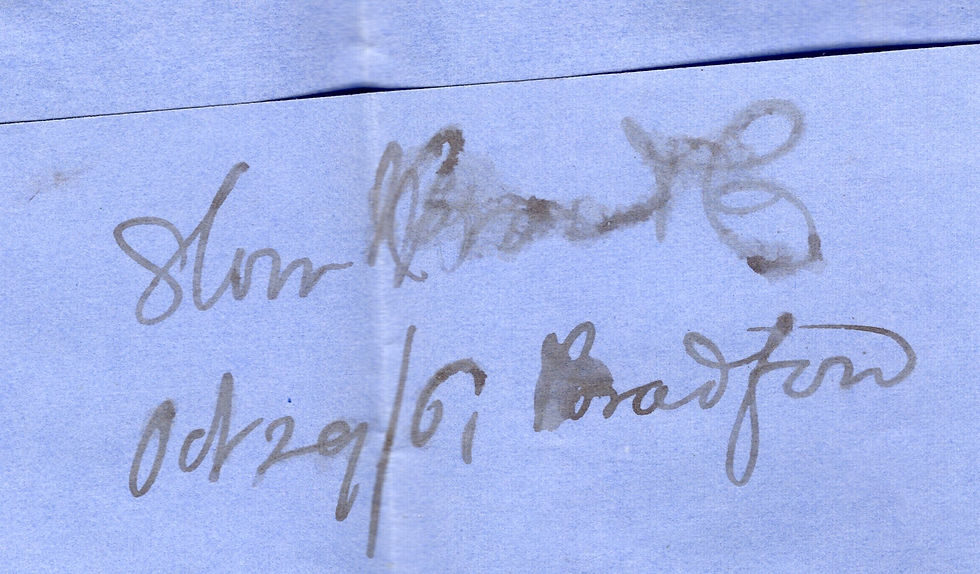
The third cover takes us across the Atlantic, and its postal markings initially suggested Liverpool as the place of origin. Closer examination shows otherwise. The cover was posted at Bradford, Yorkshire, on October 29, 1861. The reverse bears a Liverpool, October 30, 1861 transit mark, and Halifax received the letter on November 14, 1861. The stamp is the Great Britain 6d Queen Victoria lilac.
That chronology is important. The cover did not originate in Liverpool, England. It originated in Bradford and was sent to Liverpool for the transatlantic mail.
The manuscript notation of the sender appears consistent with “Shaw Harriet & Co, Oct 29/61 Bradford.” The directory evidence gives us an intriguing confirmation. White's Bradford Directory for 1861 lists “Shaw Harriet, 67 Victoria street” among the milliners. A Bradford street directory independently gives “Shaw Har., dressmkr,” at the same address.
While the surviving handwriting is not sufficiently clear to make the reading an absolute certainty, the coincidence of surname, occupation and address in the same year is unusually persuasive. The sender was very likely Harriet Shaw, dressmaker and milliner, 67 Victoria Street, Bradford.
That identification is commercially interesting. Strong's 1860 advertisement specifically associates his business with hats, caps, furs and imported manufactured goods. Harriet Shaw's trade was millinery and dressmaking. We cannot say that she supplied Strong, because the letter is lost and the evidence does not establish the nature of their transaction. But the correspondence fits comfortably within the world of British textile and millinery manufacture and Nova Scotian importing.
The postal chronology also allows a likely reconstruction of the transatlantic journey. Cunard's Europa had sailed from Liverpool on October 19 and reached Halifax on October 30. The next relevant Cunard sailing was Niagara, which left Liverpool on November 2 and arrived at Halifax on November 14. The Bradford letter therefore appears to have missed Europa and most probably crossed the Atlantic aboard Niagara.
Cover Four: Wm. Barbour & Sons, Lisburn, Ireland, March 1862

The March 1862 cover from Wm. Barbour & Sons of Lisburn to Samuel Strong. Great Britain 6d lilac cancelled by the Lisburn “304” numeral diamond; Lisburn MR 8, 1862; Halifax MR 22, 1862.
The fourth cover broadens Strong’s correspondence into Ulster and the great linen-thread industry of Ireland. It is addressed to “Mr. Saml. Strong, Halifax, N.S.” and bears a Great Britain 6d Queen Victoria lilac cancelled with the distinctive “304” numeral diamond of Lisburn. The reverse carries a Lisburn MR 8 62 datestamp and a Halifax MR 22, 1862 receiving mark: a fourteen-day journey from Ulster to Halifax.
The sender is Wm. Barbour & Sons, the Lisburn firm whose origins went back to 1784. William Barbour developed the Hilden Mill enterprise, and the family business grew into a major manufacturer of linen thread and related products. A later Barbour advertisement proudly describes the firm as a world-wide business and illustrates the extensive Hilden Mills. Although the advertisement is much later than Strong’s letter, it gives a useful sense of the scale of the company behind this small envelope.
The Barbour family history adds an especially interesting international dimension. In the 1850s, William Barbour sent his sons Thomas and Samuel to America as import agents for the thread manufactured at Hilden Mill. The venture was successful, and the Barbours acquired large mills in Paterson, New Jersey. By 1888 the firm was being described as the largest manufacturer in the world of tailors’ thread and shoemakers’ thread for hand and machine sewing. This does not prove that Strong dealt with the Barbour interests in America, but it shows that the company writing to him in 1862 was already operating within a deliberately international commercial network.
What was Barbour & Sons discussing with Strong? The letter contents have not yet been examined. The photograph of the cover suggests that a folded letter may still be enclosed, with some ink showing through the paper. If the contents survive in legible form, they could be unusually valuable: they might identify the writer, specify goods or samples, discuss prices or orders, or even name a Canadian customer or agent. For now, the cover itself is the evidence, and its commercial significance is already clear.

A later Wm. Barbour & Sons trade illustration showing the scale of the firm’s linen-thread manufacturing works at Lisburn. The image is later than the 1862 correspondence but helps visualize the industrial enterprise behind the sender.
The transatlantic route can also be reconstructed with some confidence. A Cunard postal-history record documents the S.S. America departing Liverpool on March 8, 1862, touching at Queenstown on March 9, and arriving at Boston on March 24. The Lisburn cover entered the British mail on March 8 and bears a Halifax receiving mark of March 22. The dates fit the established Cunard pattern in which Halifax was an intermediate North American port before Boston. In the absence of a manuscript ship endorsement on this cover, it is best described as very probably carried by the Cunard America, rather than as a proven routing.
Cover Five: J. & W. Campbell & Co., Glasgow, January 1863


The fifth cover takes us directly into Strong's British commercial network. It bears a Great Britain 6d Queen Victoria lilac and is addressed to Samuel Strong in Halifax. The Glasgow postmark is dated January 24, 1863. The manuscript on the flap identifies the sender as J. & W. Campbell & Co., Glasgow, with a date of January 23. The cover is explicitly endorsed “Per Cunard Steamer.” Halifax received it on February 9.
The dates make this a particularly satisfying piece of postal history. The letter was prepared in Glasgow on January 23, entered the Glasgow mail on January 24, and was sent onward to Liverpool for the Cunard transatlantic service. The February 9 Halifax receipt fits the Cunard schedule and makes the Europa the very likely vessel. Again, the qualification matters: the cover says “Cunard Steamer,” not “Europa.” The ship identification is reconstructed from the dates and service.
J. & W. Campbell & Co. was not a small local shop. The firm was founded by brothers James and William Campbell and developed into a major Glasgow drapery and dry-goods concern. Its history places the firm in the Saltmarket, then Candleriggs, and from 1856 in substantial premises on Ingram Street, where the business was conducted on a wholesale basis. William Campbell's biography describes the firm as a retail and wholesale drapery and dry-goods business dealing in textiles and fabrics and developing trading links around the world.
The Campbell family's position in Glasgow society reinforces the scale of the enterprise. Sir James Campbell, one of the founders, became Lord Provost of Glasgow in 1840–43. William Campbell was a councillor, philanthropist and prominent supporter of the Free Church. The firm therefore belonged to the world of the great nineteenth-century merchant houses of Glasgow.
This is a remarkably good fit with Strong's own position in Halifax. By 1863 his business was dealing in imported British manufactured goods, and a later advertisement specifically mentioned goods arriving from Liverpool and Glasgow. The cover does not prove that J. & W. Campbell was a supplier to Strong; the letter contents are lost. But it places the two firms squarely within the same transatlantic commercial environment.
There is also a useful distinction between this cover and the separate London cover in the group. The Glasgow cover is unusually explicit about its route: Glasgow, then Liverpool, then the Cunard mail steamship, then Halifax. It is therefore the clearest surviving example of the physical communications system behind Strong's British correspondence.
Cover Six: The London cover and the limits of what the envelope can tell us


The sixth cover is different again. It is addressed not simply to Samuel Strong but to “Messrs Saml Strong & Co., Halifax, Nova Scotia.” It bears another Great Britain 6d Queen Victoria lilac and London postal markings. A circular marking appears to include February 23, 1863, although the exact reading should be retained as a transcription rather than treated as an absolute date until the strike is clearer.
The cover is especially interesting because the manuscript material on the flap appears to connect it with J. & W. Campbell & Co., Glasgow. But the postal origin is London, not Glasgow. That creates a puzzle which the surviving envelope does not resolve.
Several explanations are possible. Someone connected with the Campbell firm may have been in London; the letter may have been forwarded to London for posting; the firm may have had a London correspondent; or the manuscript on the flap may be a later docket rather than the original return address. Without the letter contents or additional documentary evidence, none of these possibilities can safely be preferred.
What can be said with confidence is that by 1863 the business name Samuel Strong & Co. was in use, and that Strong's correspondence was reaching Halifax through more than one British gateway. The London cover therefore complements rather than duplicates the Glasgow cover. The Glasgow envelope gives us a clear Cunard route; the London envelope leaves us with a commercial and postal puzzle.
A Halifax importer in a changing commercial world
Taken together, the six covers show Strong’s business at several levels. Jacobs represents the maritime economy of Queens County. Hall represents the local merchant and shipping community around Liverpool Harbour. Harriet Shaw points toward Bradford’s textile and millinery trade. Barbour & Sons places Strong in direct correspondence with a major Ulster linen-thread manufacturer. J. & W. Campbell represents the large wholesale houses of Glasgow. The London cover adds another British commercial gateway.
This is exactly what we would expect from a Halifax importer operating in the 1850s and 1860s. Halifax was a port city whose merchants depended upon regular communications with British manufacturers, wholesalers and shipping interests. The postal covers make that network visible at the level of individual transactions.
The covers also show why postal history can be an unusually effective form of business history. A directory can tell us that Strong was a dry-goods merchant. An advertisement can tell us that he imported British manufactured goods. A newspaper can tell us that he later advertised merchandise arriving from Liverpool and Glasgow. But a surviving cover shows an actual correspondent sending something to him on a particular day, through a particular postal system.
Samuel Strong as a religious benefactor
Census data consistently list Strong as a Baptist. But Strong's religious sympathies may have been more complicated than his identity as a Baptist suggests. In 1860, Dr. John Knox of Prince Edward Island came to Halifax under the auspices of the American Christian Missionary Society to preach the Restorationist message of the Disciples of Christ. Knox reported that opposition to the movement had made it difficult to obtain a hearing, but that “a prominent Regular Baptist” had offered $2,000 (about $80,000 in today's money) toward a building “where the pure gospel could be preached.” Reuben Butchart, in his history of the Disciples in Nova Scotia, identifies that Baptist as the Halifax merchant Samuel Strong and says that the proposed building was probably the “Tabernacle” said to have been erected by Strong, with substantial additional assistance from Nova Scotia.
The evidence does not suggest that Strong himself became a Disciple. Butchart later describes the faction associated with him as “Clean Calvinist Baptists.” Strong's $2,000 subscription looks less like a conversion than an act of religious sympathy and practical cooperation.
The later history of the Halifax Disciples makes the episode still more interesting. The congregation continued after the struggles of the 1860s and eventually occupied a succession of buildings, culminating in a new church on North Street, dedicated in 1893. That building stood for nearly twenty-five years before being wrecked in the Halifax Explosion of December 6, 1917; the congregation survived and rebuilt. The evidence does not yet allow us to trace Strong’s 1860 “Tabernacle” building architecturally into the later North Street church, but it does place his unusual act of support at an early and difficult stage in the history of the Halifax Restorationist movement.
When combined with Strong's later partnership with a practicing Catholic, this episode says much about his willingness to reach across denominational divides for the greater good.
The Strong family: Henrietta Bath and the next generation
Samuel Strong married Henrietta Maria Bath on March 24, 1856, in Granville Township. Henrietta was born in Granville Centre in 1833, the daughter of Captain John Bath III and Phebe Troop. The marriage linked Strong to another Nova Scotian family with deep roots in the Annapolis Basin and maritime communities.
The surviving family records identify several children, among them Annie M., Newton Samuel, Charles Haddon, Harrington, Frank B., Blanche Eva and Percy Troop Strong.
The family later became associated with Bridgetown, closer to Henrietta's roots and the surrounding Annapolis County community. After Samuel's death in 1895, Henrietta remained connected with the family there. Her obituary says she died in 1918 at the residence of her son, while cemetery and genealogical records preserve the Strong-Bath family grouping at Riverside Cemetery.
Charles Haddon Strong
Charles Haddon Strong, born in January 1862, is an especially intriguing member of the family. His name suggests his parents may have admired Charles Haddon Spurgeon, the celebrated English Baptist minister. By 1898 he was described in the Halifax press as a popular Bridgetown merchant, and he married Sarah Pratt, daughter of Francis R. Pratt.
A later Canadian South African service record identifies Charles Haddon Strong as the guardian of his brother Frank B. Strong. That detail becomes important because Frank's life took the family story far from Nova Scotia.
Frank B. Strong and the Boer War
Frank Bath Strong's military records provide a striking contrast with the quiet commercial correspondence preserved in the surviving nineteenth-century covers. Frank enlisted in Halifax on October 20, 1899, in the Canadian Special Service Forces for service in South Africa. His regimental number was 7823. The military record gives his trade as bookkeeper, his religion as Methodist, and his next of kin as Charles Strong.
Paardeberg and Bloody Sunday
The Battle of Paardeberg was the first major battle of the South African War in which Canadians fought. More than 4,000 Boers under General Piet Cronje had been driven into a defensive laager on the banks of the Modder River, where they were surrounded by a much larger British force. On Sunday, February 18, 1900, Lord Kitchener ordered a direct assault on the Boer position. The attack became known to Canadians as Bloody Sunday. The men had to advance across open ground against well-entrenched Boer riflemen, who held a strong defensive position and were armed with modern magazine rifles. The assault failed, and the Canadian losses were severe. The 2nd Battalion, Royal Canadian Regiment of Infantry, the principal Canadian unit in the action, lost 18 men killed and 60 wounded that day, its worst single-day losses of the war.
The wider battle continued for another nine days as the British forces tightened their encirclement. Cronje finally surrendered on February 27, with roughly 4,000 Boer soldiers going into captivity. Paardeberg was consequently celebrated as the first major British victory of the war, but for the Canadians who fought there it had begun with a disastrous assault remembered for its heat, exposure and casualties.
The surviving service papers show that Frank was invalided home from South Africa and spent time at Netley Hospital in England. A contemporary newspaper report described him among the invalids returned to Canada and said he was suffering from sunstroke. Another contemporary report stated that the sunstroke had been received during the Battle of Paardeberg and that he had developed a severe disturbance characterized at the time by hallucinations and a belief that he had to return to the front.
The language of the period must be respected. Contemporary doctors and newspapers used “sunstroke insanity” as a diagnosis that could encompass serious neurological and psychiatric disturbance. Modern concepts such as PTSD should not simply be imposed upon a 1900 case. What can be said from the records is that Frank returned from the war with a serious condition and did not recover sufficiently to resume an ordinary life.
The 1911 census places Frank in the Nova Scotia Hospital as an inmate. His 1919 death record shows that he remained associated with the hospital until his death, when he was recorded as single and a clerk, with burial at Bridgetown. The record gives diabetes as the immediate cause of death.
From one war to another
The Strong family story thus crosses several different eras of conflict. When he received the correspondence contained in these postal covers, Samuel Strong's commercial life was unfloding during the American Civil War, when Halifax was deeply connected to the Atlantic trade affected by the conflict. A generation later, his son Frank served in the South African War. And by the the time of his death in 1919, the Nova Scotia Hospital system was receiving soldiers with serious mental and physical difficulties from the First World War.
The six covers belong to the first stage of that story. They show the family at the point where commerce, shipping and correspondence were the dominant themes. The later records show how quickly that world could give way to a very different one.
A career with an uncertain ending
Samuel Strong's later life was less stable than the confident commercial correspondence of the early 1860s might suggest. The Nova Scotia Historical Quarterly's account of the Elmwood property records that Strong, a dry-goods merchant, purchased five and a quarter acres from George Taylor in 1865 for £280 and apparently built a summer home there. He held the property for less than a year before it was sold at auction.
The same historical account describes Strong as having a “rather spotty career” and records financial difficulties in the 1870s. In 1874 newspapers reported that Strong, then living in Arichat and formerly of Halifax, had been arrested on a complaint by Emerson Bligh of A. B. Bligh & Co., alleging that he had obtained goods under false pretences. That later episode should not be projected backward onto the earlier covers. The envelopes document a functioning commercial network in the early 1860s; they do not tell us what happened to the business later.
This is one of the reasons the covers are so valuable. They capture Strong at a particular moment, before the later difficulties had unfolded. They show the merchant not as a static directory entry but as a person receiving correspondence from shipowners, milliners, local merchants and major British wholesale houses.
What the six covers reveal
Seen individually, the covers are modest objects. A 3d Nova Scotia stamp. A 5¢ domestic issue. A 6d Queen Victoria lilac. A Liverpool transit mark. A Cunard endorsement. A Halifax receiving stamp. Most do not preserve the contents of the letters that once passed through them.
Seen together, they form a network.
· W. S. Jacobs links Strong to the maritime and shipowning economy of Liverpool, Queens County.
· J. R. Hall links him to the merchants and shipowners of Brooklyn and the Liverpool Harbour community.
· Harriet Shaw appears to link him to Bradford's millinery and dressmaking trade.
· Wm. Barbour & Sons links him to the linen-thread manufacturing world of Lisburn and to the international reach of an Ulster industrial firm.
· J. & W. Campbell & Co. links him to a major Glasgow wholesale drapery and dry-goods house.
· The London cover shows that his business correspondence also moved through London, although its precise routing and relationship to Campbell remain unresolved.
There is a second network as well: the postal network. The covers move through local Nova Scotian post offices, British provincial mail, Liverpool as a transatlantic gateway, and Cunard's steamship service. They show how the nineteenth-century merchant's business depended upon an infrastructure that was both physical and informational.
And there is a third network—the human one. The people behind the covers were not interchangeable names. Jacobs was a shipowner and mariner. Hall became a merchant, shipowner, J.P. and postmaster. Harriet Shaw appears in Bradford as a milliner and dressmaker. The Campbells belonged to one of Glasgow's important mercantile families. Their envelopes preserve a tiny part of their interaction with Samuel Strong.
What we still do not know
The temptation in postal-history research is to let a plausible reconstruction become a fact. These covers provide several opportunities to resist that temptation.
· We do not know what most of the six letters contained.
· We cannot prove the exact business transaction between Strong and W. S. Jacobs.
· We cannot prove that Harriet Shaw supplied Strong, although the occupation and commercial context make the correspondence plausible.
· The Niagara identification for the 1861 Bradford cover is a timetable reconstruction; the cover has no Niagara marking.
· The Europa identification for the January 1863 Glasgow cover is similarly inferred from the Cunard service and postal dates; the cover says only “Per Cunard Steamer.”
· The precise reason the sixth cover was posted in London, despite manuscript material apparently associated with J. & W. Campbell & Co., remains unresolved.
These qualifications do not weaken the story. They are part of it. The value of the covers lies in the fact that they preserve enough evidence to reconstruct a historical setting while still leaving some questions open.
A Dispersed Correspondence
There is another reason these six covers may be more important than their number suggests. Strong’s business correspondence was apparently broken up and sold to philatelic collectors rather than preserved as a unified business archive. If that account is correct, the covers now known to survive may be only a small fragment of a much larger correspondence.
That possibility is exciting from a postal-history perspective. The surviving examples now span Liverpool, Nova Scotia; Brooklyn and Queens County; Bradford; Lisburn; Glasgow; and London. They suggest a merchant whose business relationships extended across Nova Scotia and throughout the British Isles. Other Strong covers could still exist in private collections, dealer stocks, auction archives, or online marketplaces, perhaps without being recognized as part of the same correspondence.
A future Samuel Strong cover could add another correspondent, another source of merchandise, another shipping route—or, most tantalizingly, another surviving letter with contents.
Conclusion: six envelopes and a vanished correspondence
Samuel Strong left no great archive of business letters that can be opened today to reveal the details of his daily transactions. Instead, at least these six envelopes have survived. They are easy to overlook: small pieces of folded paper bearing stamps that, by themselves, say little. Yet each one points outward—to a town, a business, a correspondent, a ship, a postal route, or a wider commercial network.
But the stamps and postmarks provide dates. The dates provide routes. The addresses provide people. The people lead to directories, newspapers, shipping registers, census records, church histories and cemeteries. Piece by piece, the envelopes reconstruct the commercial world in which Strong lived.
The covers therefore tell us something that a conventional biography might easily miss. Samuel Strong was not simply a name in a Halifax directory. He was a node in a network that extended from Nova Scotian shipowners and merchants to British textile and millinery businesses, and that network depended upon the regular movement of steamships, mail and information.
The later history of the Strong family carries the story into another century: religious institutions, family businesses, the South African War, the Nova Scotia Hospital. But the six covers belong to an earlier and quieter moment. They preserve Samuel Strong when the principal drama was commerce—the ordering, selling, shipping and paying for goods across the Atlantic.
That is why these little pieces of postal history matter. The letters are gone, but the envelopes remain. And sometimes the envelope is enough to let us reconstruct the world in which the letter once mattered.
Research notes and principal sources
The following sources and records underpin the identification and interpretation in this draft. Where a conclusion is inferential, the text above says so explicitly.
· Nova Scotia Provincial Wesleyan Almanack, 1860 — Samuel Strong advertisement describing him as a general importer of British and foreign manufactured goods, including hats, caps and furs, at Acadia Corner.
· Halifax business directories, including the 1863 directory — Samuel Strong listed in the dry-goods trade at 150 Granville and 84 Upper Water; residence at 9 Poplar Grove.
· Halifax Morning Sun, July 1863 — notice of James M. Brown entering partnership with Samuel Strong; business thereafter Samuel Strong & Co., 150 Granville.
Halifax Business Directory, 1863 — Halifax Catholic Institute: James M. Brown listed as president; the Institute is described as having about seventy members.
Hutchinson’s Nova Scotia Directory, 1864–65 — James M. Brown listed in dry goods at 150 Granville, with residence at 111 Park North.
· Halifax Morning Sun, November 1863 — Samuel Strong & Co. advertisement mentioning goods arriving from Liverpool and Glasgow.
· Nova Scotia Historical Quarterly, Special Supplement (1975) — Samuel Strong, the Elmwood property, later financial difficulties and the 1874 legal trouble.
· Nova Scotia seafarers/shipping records — William Jacobs of Liverpool as owner of the brigantine Caledonia and schooner Nova Scotia.
· White's Bradford Directory, 1861 — Shaw Harriet, 67 Victoria Street, under the millinery listings.
· Bradford Street Directory, 1861 — Shaw Har., dressmaker, 67 Victoria Street.
· Liverpool Transcript, April 7, 1859 — John Hall of Brooklyn appointed Justice of the Peace for Queens County.
· Liverpool Transcript, May 24, 1860 — launch of the schooner Atalanta at Brooklyn; John R. Hall, Esq., named as an owner.
· John R. Hall biographical and obituary material, including the 1889 Liverpool Advance obituary — Cromarty birth, Brooklyn career, shipping, district clerkship, Justice of the Peace, and twenty-eight years as postmaster.
· The Old Brooklyn Cemetery, Tim McDonald, 1996 — inscription and biographical notes for John R. Hall.
· 1861 Nova Scotia Personal Census, Queens County — household headed by John R. Hall.
· The Glasgow Story and Glasgow West End Address sources — history of J. & W. Campbell & Co., its wholesale drapery/dry-goods trade and move to Ingram Street in 1856.
· Reuben Butchart, The Disciples of Christ in Canada Since 1830, Part II: Nova Scotia — retrospective account of John Knox's 1860 Halifax work, the $2,000 subscription by a prominent Regular Baptist identified as Samuel Strong, the “Tabernacle,” and the later history of the Halifax Disciples congregation.
· Public Archives of Nova Scotia, Glimpses of Halifax, 1867–1900 — historical note on the later Tabernacle Baptist Church and its founding in the 1870s; this should not be assumed to be the same building as the 1860-era Disciples “Tabernacle.”
Wm. Barbour & Sons cover, Lisburn to Halifax, March 1862 — 6d Queen Victoria lilac, Lisburn numeral “304,” Lisburn MR 8 62, Halifax MR 22 1862; possible surviving folded letter contents.
Helen Calcluth, “The Kilbarchan Linen Merchants, 3: Barbour Family Descendants in Ireland, USA and England” (2022) — Barbour family origins, Hilden Mill, American import agents in the 1850s, and expansion to Paterson, New Jersey.
Wm. Barbour & Sons trade advertisements — later illustrations of the Hilden Mills and the firm’s linen-thread business; used as contextual evidence for the scale and international reach of the enterprise.
Cunard postal-history and sailing records for 1862 — S.S. America departed Liverpool March 8, touched Queenstown March 9, and reached Boston March 24; the March 22 Halifax arrival on the Strong cover makes America a strong but not proven routing.
· Frank B. Strong military service record, Canadian Special Service Forces, South Africa 1899–1900, Regimental No. 7823.
· Contemporary reports of Frank B. Strong's return from South Africa in 1900 and later Nova Scotia census/death records documenting his institutionalization and 1919 death.


Comments