
William J. Coleman, Hat, Cap, and Fur Merchant, Halifax


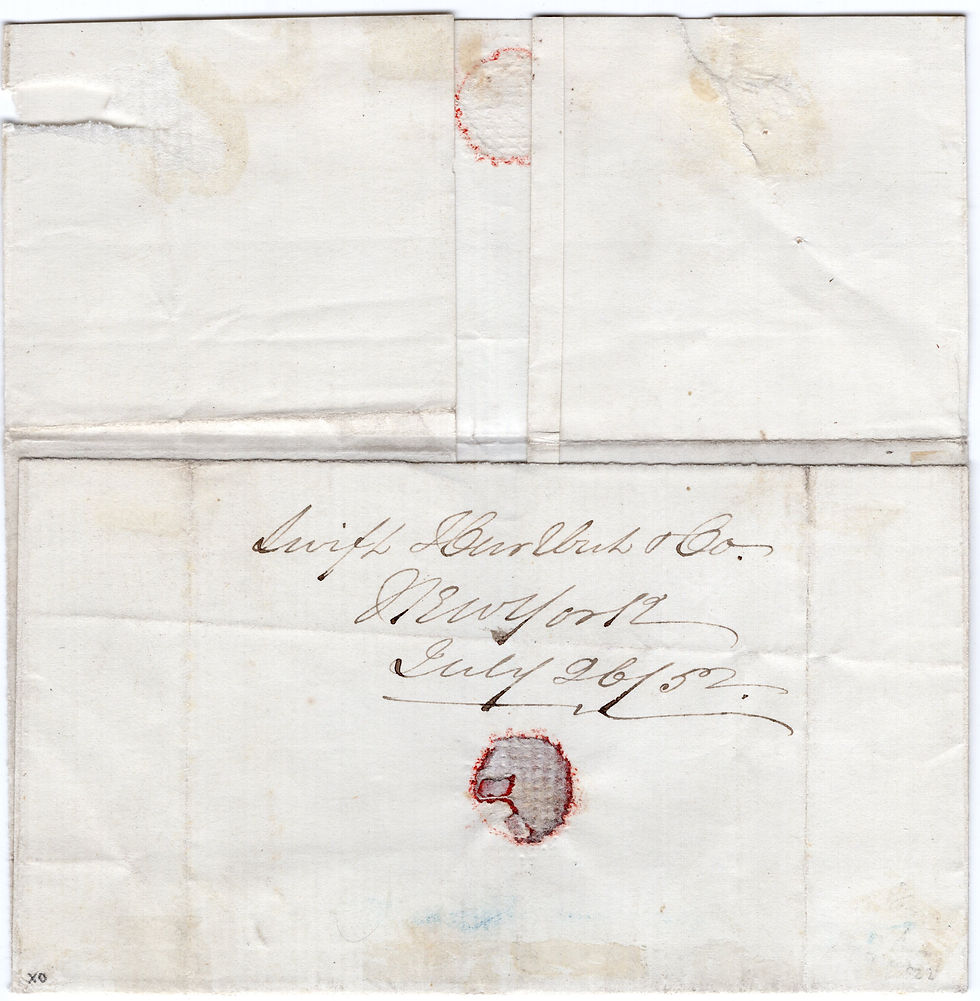
Four United States stamps — a 1¢ blue Franklin (Scott #9) and three 3¢ dull red Washingtons (Scott #11), ten cents in all — franked a folded cover mailed July 26, 1852, from New York to Messrs. W. J. Coleman & Co., Halifax, Nova Scotia. Two NEW YORK JUL 26 circular datestamps tie the stamps, a manuscript “per Steamer” at left marks it as travelling by steam packet, and a black “5” alongside a second “5” in blue pencil are best read as the accounting split of the 1851 US–British North America postal treaty's 10¢-per-half-ounce rate — five cents retained on the American side, five credited across the border. Backstamped HALIFAX, N.S., AU 6 1852 on the reverse, the cover made the run from New York to Halifax in eleven days, consistent with an ordinary coastal steamer rather than the transatlantic Cunard packet, which touched Halifax only outbound from Liverpool. Inside the back flap, the sender identified themselves plainly: “Swift, Hurlbut & Co., New York, July 26/52.”
The Sender: Swift, Hurlbut & Co.

An 1852 New York directory lists “Swift Hurlbut & Co., hats, 207 Pearl” — a match confirmed beyond doubt by a surviving trade circular the firm printed the year before, in January 1851: “Swift, Hurlbut & Co., Importers, Manufacturers and Dealers in Hats, Caps, Furs, and Straw Goods, No. 207 Pearl Street, New-York, near Maiden Lane,” illustrated with a woodcut of their own four-story storefront and pitched, in the boilerplate language of the trade, to “the Southern and Western trade.” Circulars like this were printed in bulk and mailed widely; a nearly identical surviving example, addressed to a Tennessee merchant and apparently the only copy known to survive anywhere, shows the same firm reaching customers as far off as Madisonville, Tennessee — Halifax was simply one more stop on a genuinely national customer list. The inside page advertised buffalo robes and a run of named hat styles, several after the celebrities of the moment — “Jenny Lind” and “Kossuth” hats among them, for the Swedish soprano and the exiled Hungarian revolutionary then touring the United States to enormous fanfare.
The firm's two names both point to real, closely connected people. John H. Swift was a New York-born merchant, about forty-three when this cover was posted, married to Mary Elizabeth, with at least one son, John L., and by his church affiliation an Episcopalian at St. Clement's. Henry A. Hurlbut, the senior of the two Hurlbut brothers in the firm, was born December 8, 1808, in Hartford, Connecticut, the son of Ebenezer Hurlburt and Fanny Brewster, both of whom he lost within a year of each other before he turned twenty-two; he built a long and evidently prosperous New York career afterward, dying in 1897 at eighty-eight. His younger brother and partner, Francis E. Hurlbut, thirteen years his junior and also Hartford-born, was working as a hat finisher — the hands-on trade itself — as recently as the 1850 census, before the move into the wholesale side of the business by the time this letter went out. Whatever the ordinary business of writing to a Halifax customer that July, it came only months before a private sorrow: Francis's small daughter, Malvina, not yet five, died that November.
Top Hats, Not Bonnets
Neither Coleman's shop nor Swift, Hurlbut & Co. would have been in the business of women's bonnets — those were a milliner's trade, entirely separate. What both houses actually dealt in were men's hats, chiefly the top hat, whose recognizably modern form is generally traced to a Middlesex hatter named George Dunnage in 1793. Early top hats had a distinctly curved, hourglass profile, narrower at the middle of the crown than at brim or top, and were made of beaver fur felt or silk for wealthier customers, stiffened wool felt for everyone else. By the 1850s — the very decade this cover was posted — the style had grown taller still, into the so-called stovepipe hat, sometimes reaching nearly eight inches. Around 1840 the French hatter Antoine Gibus had already patented a spring-mounted collapsible version, the chapeau claque or “opera hat,” built to fold flat for storage under a theatre seat; and in 1849 English hatters had introduced the lower, harder-brimmed bowler, a style that would cross the Atlantic soon enough and, by century's end, settle into everyday wear alongside the top hat's more formal role.
There was a darker side to the trade Francis Hurlbut had worked as a young man. Felt-making relied on a process called carroting, in which fur was treated with an orange solution of mercuric nitrate to help it matt and shrink properly — a step that released mercury vapor into poorly ventilated hatting shops for decades on end. Chronic exposure produced a recognizable cluster of symptoms — tremors, slurred speech, irritability, personality change — that gave rise to the expression “mad as a hatter” long before Lewis Carroll's character made it famous. The condition wasn't formally documented until 1829, in St. Petersburg, and it took decades more for medicine and manufacturing to catch up with it: New Jersey's hatters were the subject of a detailed occupational study in 1860, the French Academy of Medicine confirmed the hazard outright in 1869, and mercury-free alternatives followed in the mid-1870s, though a safer American process patented in 1888 was, by most accounts, simply ignored for years afterward. Whether Francis Hurlbut's own years as a hat finisher exposed him directly to mercuric nitrate isn't something the record here can settle — finishing came after carroting in the production sequence — but he was, at the least, working inside a trade that quietly poisoned a good many of the people who practiced it.
William J. Coleman, Hat, Cap, and Fur Merchant

William J. Coleman was born around 1813–1814 — his 1896 death registration, giving his age as 82 years, 2 months, and the 1881 and 1891 censuses all cluster tightly there, against a single outlying 1816 recorded on the 1871 census. He was born at Sackville, Halifax County, and the family's own origin, recorded as “Irish” on several censuses, turns out on closer inspection to describe his father's birthplace specifically — his father was Irish-born, his mother English, while William himself was Nova Scotia-born throughout. He married Hannah Jane Lockhart at Halifax on April 22, 1841, when he was in his late twenties, and the couple went on to raise nine children together over the following decade and a half.
By January 1866, a half-page advertisement in Hutchinson's Halifax directory shows him already well established: “W. J. Coleman, Importer and Dealer in Hats, Caps, Ladies' Furs, Buffalo Robes, Trunks, Hat Cases, &c., &c., Wholesale and Retail,” trading from 129 Granville Street and offering, tellingly, “Cash paid for all kinds of shipping furs” — a two-way trade, buying raw furs for export as well as selling finished goods, of exactly the kind that would put him in regular correspondence with a New York hat-and-fur wholesaler like Swift, Hurlbut & Co. By the late 1870s the business, now trading as Coleman & Co. at 143 Granville Street, had drawn in at least one son, William J. Coleman Jr., as a partner at his own separate address, and possibly a third name, Edward L. Coleman, whose exact relation to the family isn't confirmed. The 1877–78 directory also places a second son, Albert England Coleman, boarding separately as a student-at-law — training for a different profession from his father's trade entirely. The same directory page carries an entirely separate cluster of Colemans — Catherine, widow of Patrick; Daniel, a janitor at St. Patrick's school; Patrick, a printer; Stephen, a tailor — whose Catholic institutional ties mark them out clearly as an unrelated family, distinct from William's own well-documented Methodism.

That same directory caught the family not long before a hard stretch of losses. A son, Alexander McDonald Ross Coleman, had already died in infancy in 1858. Frank R. Coleman died in 1876, only twenty-one. And in July 1879, within about two weeks of each other, both William J. Coleman Jr. and Albert England Coleman died — the eldest son and the law student, gone within a fortnight of one another, for reasons nothing in the record so far explains. Of the nine Coleman children, four sons were lost before their father; among the survivors, Ida Pamela Coleman married into the Barss family — a name that carries real weight in Nova Scotia's privateering history, though nothing here confirms any link to that specific branch — and Charles Alfred Coleman trained as a physician and settled in London, England, marrying Jessie Mitchell McKie there in 1882 and giving his father's rank, in the English parish register, as “Gentleman.”
Hannah Jane Coleman died suddenly in March 1893 — a Halifax newspaper reported she had “suddenly expired” at home “while chatting with some friends” — and was buried at Camp Hill Cemetery. William followed her there on April 9, 1896, aged 82 years and 2 months, a retired merchant dying of hemiplegia at his home on South Park Street after a working life of at least thirty years in the hats-and-furs trade, and very possibly longer — a trade already well underway, if this cover is any indication, by the time a New York firm addressed a routine ten-cent business letter to “Messrs. W. J. Coleman & Co.” in the summer of 1852.
Ten cents in stamps, an eleven-day crossing, and a routine notice from a Pearl Street wholesaler: an ordinary piece of the hat-and-fur trade in motion, addressed to a Halifax merchant who would spend the better part of five decades in that same business, outlive four of his nine children, and close out a correspondence that, a century and a half later, still reads as exactly what it was — two trading houses, an ocean's remove from being competitors, simply doing business as usual.


Comments