
Windsor, Nova Scotia: A Port Built on Gypsum and Ships
- 2 days ago
- 4 min read


The rate
The pair of 10¢ stamps, together paying 20¢, is double the standard 10¢ Nova Scotia–United States cross-border letter rate — indicating this letter weighed more than the ½-ounce single-rate limit. As a partial cover, the address is truncated and any further backstamps may be missing, which limits how much more can be read from the piece itself; the specific sender’s name has not survived on what remains of the cover.
J.F. Whitney & Co.
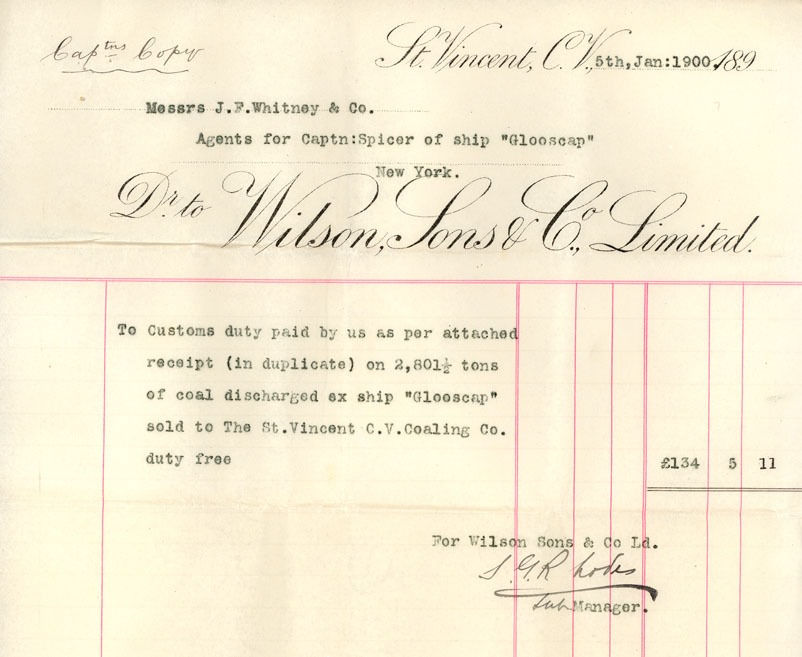
The 1861 New York City Directory lists “J. F. Whitney & Co., mers, 2 B’way, & grindstones, 58 Wash’n” — a merchant house at 2 Broadway with a separate grindstone-trading address on Washington Street. Dalhousie University Archives holds a file of correspondence, dated 1855–89, between Whitney and Frieze and Roy, shipping merchants of Maitland, Hants County — proof that this New York firm did regular business with at least one Minas Basin shipping house in Windsor’s own county in exactly this period. A separate, much later 1900 invoice shows Whitney acting as New York customs agents for the Nova Scotia ship Glooscap, captained by a member of the Spicer family of Spencer’s Island, Cumberland County. Neither the Frieze and Roy correspondence nor the Spicer invoice can be tied directly to this particular cover — the surviving piece doesn’t preserve a sender’s name, and Windsor, Maitland, and Spencer’s Island were three distinct (if related) Fundy shipping communities — but together they show that Whitney served as a general New York agent and correspondent for a whole network of Nova Scotia gypsum and shipping firms along the Bay of Fundy, of which this letter was very likely simply one more example, from one of Windsor’s own merchant or shipbuilding houses.
Windsor and the gypsum trade
Windsor’s own economy through the 19th century was built above all on gypsum. Deposits had been identified in Hants County as early as the 1770s, and by the 19th century Windsor merchants were shipping large quantities of the mineral — known then simply as “plaster” — to American markets for use as fertilizer and, later, in plaster and cement manufacture. Some of this trade operated outside official channels: an 1820 dispute over unlicensed gypsum shipments to Passamaquoddy Bay escalated into the so-called “Plaster War,” in which local Nova Scotia smugglers successfully faced down New Brunswick officials attempting to bring the trade under control. By 1867, gypsum was being exported from twenty-five different Nova Scotia ports. Windsor merchants, including Henry Goudge (1805–1841), a shipbuilder and Reform member of the House of Assembly for Hants County and later Windsor township, petitioned in 1834 to have Windsor made a free port specifically to facilitate the gypsum trade.
Windsor’s shipbuilders
Gypsum exports and shipbuilding grew up together in Hants County, and Windsor was one of the leading shipbuilding ports on the Minas Basin, alongside Hantsport, Newport Landing, and Maitland. Two men dominated the industry in Windsor itself: Shubael Dimock, whose shipyard was, by contemporary account, “for years a busy place, the country people bringing in timber by the team load,” and Bennett Smith (1808–1886), the foremost shipbuilder and shipowner in Windsor’s history. Smith, born on Smith’s Island at the junction of the Avon and St. Croix rivers, inherited his father’s shipyard there in 1832 and, working with his brothers, launched his first vessel, the brig Matchless, in 1839 — the same broad era in which this cover’s own correspondent was presumably active. Over his career Smith built 27 vessels, owning and operating all but one, held shares in eight more, and at his peak in 1867 owned a fleet of twelve ships; he briefly served in the Nova Scotia House of Assembly for Hants County in 1858–59. His final and most celebrated Windsor-built ship, the 1,318-ton full-rigged Black Watch, launched in May 1877 at a cost of $50,000, wrecked off Fair Isle, Scotland, only four months later on her maiden voyage — after which Smith closed his Windsor shipyard for good, reportedly following a wage dispute with his workers. He was also a founder, in 1865, of the Commercial Bank of Windsor, established specifically to provide marine insurance to the town’s shippers and shipbuilders. Smith’s son, Thomas Barlow Smith (1839–1933), followed his father into both shipbuilding and merchant trade, and went on to a long career as a Hants County MLA and as an author of adventure fiction.
Contemporary historian W.C. Milner, a former head archivist of the Nova Scotia branch of the Public Archives of Canada, ranked Bennett Smith among the three leading shipbuilders of the entire Minas Basin, alongside Ezra Churchill of Hantsport and William Dawson Lawrence of Maitland — placing Windsor firmly at the center of a shipbuilding and shipping world that also, a short distance up the Basin, included Frieze and Roy’s Maitland firm and, further along the Fundy shore, the Spicer family of Spencer’s Island. It was against this dense, interconnected backdrop of gypsum shipping and wooden shipbuilding that a Windsor merchant sat down in June 1861 to write a double-weight letter to a New York mercantile agent — one working relationship among many linking Hants County’s ports to American markets in this period.


Comments