
A Dry Goods Letter from Saint John to Annapolis Royal
- 2 days ago
- 5 min read
Updated: 8 hours ago

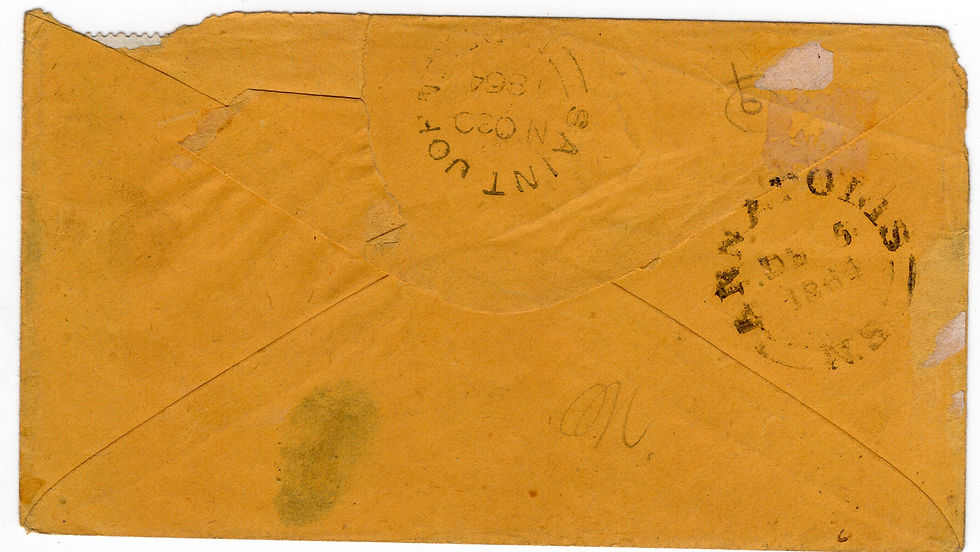
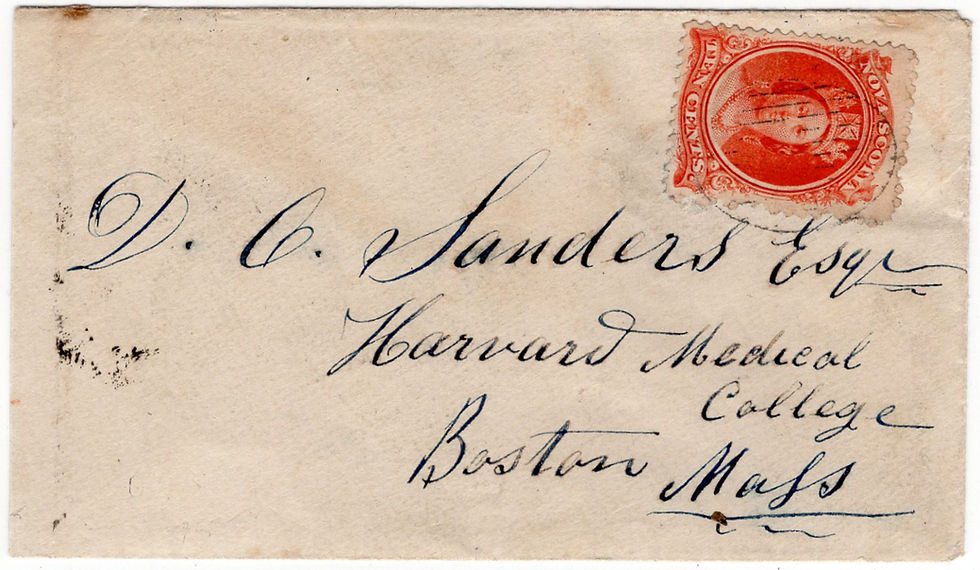
A cover sent from Magee Bros. & Co., Saint John, N.B., to Miss Foster, Annapolis, N.S., October 1864.
The cover itself:
• 5¢ New Brunswick stamp (Queen Victoria portrait, 1860 decimal issue), tied with a grid cancel
• Docketing, upper left, in a later hand: “1864,” then “Magee Brothers, Bill 262.07 C Decr 20th/64”
• Backstamps: Saint John, N.B. Nov 30, 1864, and an Annapolis, N.S. DE 5, 1864


Magee Bros. & Co.:
The firm was run by brothers John Magee and William Magee of Saint John. John Magee was born in Enniskillen, Ireland, and came to Saint John as a young man, entering the employ of the dry goods firm of Lawton & Vassie before he and William started Magee Bros. & Co., which rapidly became one of the city’s foremost dry goods establishments, operating from the Imperial Building at the corner of King and Prince William Streets. Shortly before the great Saint John fire of June 20, 1877, the firm retired from dry goods and moved into coal and shipping; John Magee was for some years a director of the Springhill coal mines. He lost heavily in the 1877 fire, which destroyed both his Water Street business block and his residence, but rebuilt both. He served as Alderman for Duke Ward (1879–1882), was long connected with the Saint John Agricultural Society, kept a herd of Jerseys with William on a Marsh Road farm, and was a member of the Trinity Church Corporation. John Magee died suddenly on October 12, 1885, age 59, and was buried at Fernhill Cemetery, Saint John, survived by a wife and six children.
An October 1864 letter from the firm falls comfortably within its active dry-goods period, decades before the shift into coal and shipping.
Miss Foster of Annapolis Royal:
The addressee, given without a first name, turned out to be a real puzzle worth solving. Hutchinson’s 1864 and 1866–67 directories list “Foster S. & Co., dry goods and groceries,” Annapolis Royal — a firm that also appears repeatedly in the Easson family papers at Nova Scotia Archives (MG 1 vol. 3478), which record numerous accounts between local farmer David Easson and S. Foster & Co. for salt, nails, boots, whetstone and molasses, credited against wood, spanning at least 1864 to 1870. A surviving 1869 invoice from the firm, addressed to a customer named Caroline Eason and signed “S. Foster & Co.,” confirmed the business was a real, functioning general store extending credit accounts to local customers.
The 1871 census resolved the initial: Susan Foster, age 45, single, and John Foster, age 40, single, merchant, were living together in Annapolis Royal — evidently an unmarried brother and sister running the family business jointly. Lovell’s 1871 Nova Scotia directory makes the ownership explicit: “Foster, John, of Miss Susan Foster & Co.” and “Foster, Miss Susan, & Co., hotel and store keeper” — Susan, not John, was the named proprietor, with the business having expanded to include hotelkeeping alongside dry goods. That a Saint John wholesale firm would write simply to “Miss Foster, Annapolis” without a first name makes sense in this light: she was the recognized head of an established local firm, not merely a customer.
Two earlier covers addressed to Susan Foster herself:
Two further covers push the documented record of her leadership back a full nine years before the 1871 census, confirming she was already running the business, addressed directly by name, as early as 1862:
• A cover from Halifax, April 1862, franked with a Nova Scotia 5¢ stamp, addressed “Madam Susan Foster & Co., Annapolis.” Docketing in the corner reads “Mess. Black & Brother, April 3/862, Bill Rigging $859.87.” Hutchinson’s 1864–65 directory lists a Black Brothers & Co., hardware, 51 and 53 Upper Water Street, Halifax — very likely run by Martin P. and William L. Black, both individually listed as hardware merchants at the same address — a natural correspondent for a substantial “rigging” account of this kind. Backstamped Halifax, N.S., AP 28 1862.
• A cover from Boston, July 1862, franked with a US 10¢ stamp and marked with the red oval “U.S. 10cts PAID” international rate handstamp, addressed “Mrs. S. Foster & Co., Annapolis, Nova Scotia.” Docketing reads “Boston July 22/62, Cash sent $14.39, by Capt. Caily” — a cash remittance carried personally by a ship’s captain, a common and trusted method of moving small sums across the border in this period. Backstamped Annapolis, N.S.
Both covers style her “Madam” or “Mrs.” Susan Foster rather than “Miss” — likely a general courtesy title extended to an adult businesswoman of standing, rather than evidence of marriage, since her actual marriage to Edwin Ryerson did not take place until a decade later, in 1872.
Susan Foster’s family:
Susan Forbes Foster was born March 17, 1821, in Annapolis County, one of nine children of Joseph Foster (1771–1848) and Jane Ray Foster (1775–1864), who married in Granville in 1795 and raised most of their family in Nictaux, Annapolis County — the same small community that, in unrelated research, turned out to be the home of Bamford Stephen Willett, sender of a quite different 1862 cover to Bridgewater. Susan’s mother Jane died on October 26, 1864, just weeks before this cover was posted.
Joseph Foster was in turn the son of Ezekiel Foster (1731–1819), born in Holliston, Massachusetts, who arrived in Nova Scotia around 1760 as part of the New England Planter migration that resettled Annapolis County following the expulsion of the Acadians — a full generation before the Loyalist wave of 1783, and a different colonial story from the Loyalist and Huguenot ancestries traced in other covers from this collection. Ezekiel’s first wife, Mary Roberts, died in Granville in 1765; he remarried Ruth Farnsworth in 1770, who lived to be 100. By the time Susan was born in 1821, the family had already been established in Annapolis County for four generations.
Susan’s later life:
Susan worked in the family firm into her late 40s. On June 5, 1872, at age 49 (per the marriage record; other sources give 51), she married Edwin Bergoin Ryerson, a 51-year-old widower and farmer of Annapolis, born in Clements Township, son of John and Sophia Ryerson. The Ryerson genealogy traces Edwin’s own ancestry to John Ryerson (b. 1779, New York) and Sophia Ruggles, a granddaughter of the Massachusetts Loyalist judge and Stamp Act Congress president General Timothy Ruggles; Edwin was Sophia’s twelfth child, previously married to Mary E. Elliot. Barely seven weeks after Susan’s wedding, her brother and business partner John McLeod Foster died, on July 27, 1872 — likely marking the effective end of the family dry goods firm.
Susan built Hillsdale House in 1859, when she was about 38, and operated it as a first-rate inn — the fuller realization of the “hotel” side of her business already noted in the 1871 directory, though evidently underway more than a decade before that listing, and even before the earliest cover addressed to her found here. Still operating today at 519 St. George Street, Annapolis Royal, more than 150 years later, Hillsdale House hosted prestigious guests, including the young Prince of Wales, the future King George V, and his party in 1884. Susan was widowed when Edwin died on August 24, 1891, and she died on December 22, 1895, in Annapolis Royal, age 74, buried at Garrison Graveyard.
Summary:
What began as an unremarkable business cover — a Saint John dry goods wholesaler writing to a customer identified only as “Miss Foster” — turned out to trace back to a well-documented Annapolis Royal woman who ran a family dry goods business with her brother before going on to build and run Hillsdale House, a celebrated local inn that would later host a future king, all set against a Foster family lineage reaching back to the 1760 Planter settlement of Annapolis County.



Comments