
A Halifax Letter to a Boy at School in London
- 2 days ago
- 7 min read


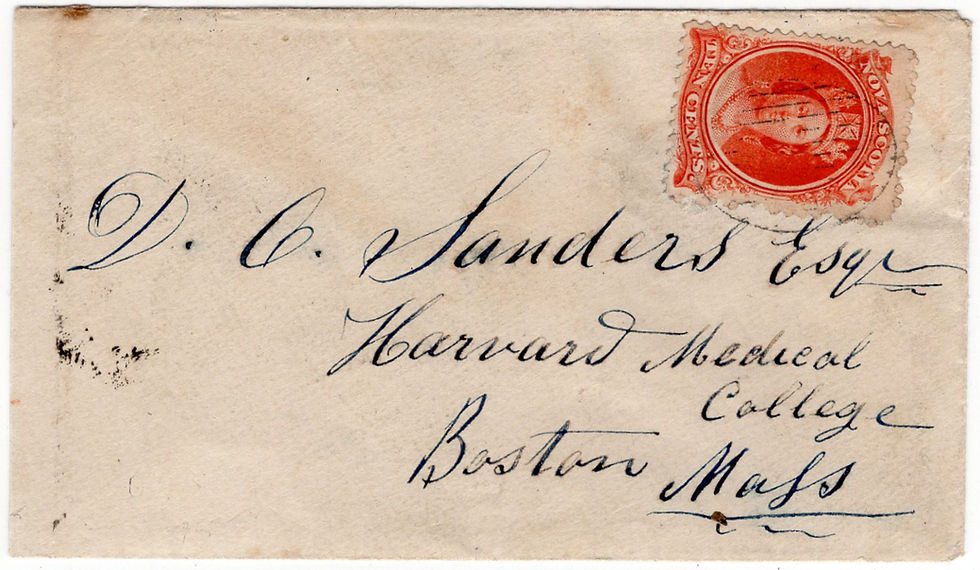
A stampless cover, sent from Halifax, Nova Scotia, December 13, 1858, to Benjamin G. Jenkins, care of (Rev. A. Stewart), Palmer House, Holloway Road, London N. Postage paid in cash, marked by a red boxed “HALIFAX PAID DEC 13 1858 NOVA SCOTIA” tombstone handstamp. A bold manuscript rate mark, very likely reading “1/–” (one shilling) — the standard Cunard packet rate for a half-ounce letter carried directly between Halifax and Liverpool since 1839. Red circular “PAID LONDON DE 30 1858” arrival mark — a transit of about 17 days, consistent with the Cunard steamship schedule of the period. An embossed floral seal on the back flap; a later pencil “15/–” on the reverse, almost certainly a dealer/collector valuation rather than a postal marking. A docketing note, “1858 Dec,” in a later hand — likely added for filing reference
London’s private boarding schools in the 1850s
Palmer House was one of a vast number of small, privately-run “proprietary” schools that filled Victorian London in this period — by the 1830s, private day and boarding schools for boys and girls in Middlesex offered primary and secondary education of every standard, though their number and quality varied enormously since directories were inaccurate and schools were often short-lived, with pupils attending erratically. An 1851 estimate put the average school life of a middle-class child at only about five and a half years. A survey of 29 private schools advertised in Chelsea alone in 1861 found only eleven were solely for boys, and just a handful of masters held any formal accreditation through the College of Preceptors.
These small establishments — often run by a single proprietor (like Philip Stewart at Palmer House) out of an ordinary townhouse, with a brother or son taken on as assistant master — were the typical destination for boys whose parents wanted an English education but couldn’t or didn’t send them to the famous “public” schools like Eton, Harrow, or Rugby. Those grander schools were reserved for upper-class boys, generally from around age ten, with a curriculum weighted heavily toward Latin, Greek, and games. A colonial family like Benjamin Jenkins’s — comfortable enough to afford an English education, but not moving in the circles that produced Eton or Harrow boys — fits well with the smaller proprietary-school model Palmer House represents: personal, small-scale, and often quite fluid in its arrangements, as shown by Benjamin’s own progression from pupil to assistant master within the same household.
Benjamin G. Jenkins
Census and marriage records trace a full, well-documented life:
• Born Nova Scotia, c. 1841, son of William Jenkins, “Gentleman”
• 1861 census, Greenwich, Kent — age 20, living in the household of Rev. Alexander Stewart (age 34, “Head”), occupation Assistant Master. This is almost certainly the same Rev. A. Stewart named on the 1858 cover — the household had evidently relocated from Holloway to Greenwich between 1858 and 1861, and Jenkins, formerly a pupil, was by then teaching there.

• Also in 1861: matriculated at the University of London, July 1861, as a private student; passed his Intermediate Arts examination in 1864
• 9 April 1870 — married Isabella (Buckton) Hardinge, a 37-year-old widow from Hull, Yorkshire, at St Saviour’s Church, St George Hanover Square. He was recorded as a 29-year-old bachelor, “Student of the Bar,” residing at 4 Moreton Place; his father is named as William Jenkins, Gentleman.
• September 1870 — named defendant in a libel case at the Liverpool Assizes, brought by Messrs. Inman, owners of the steamship City of Boston, over a letter Jenkins had written to The Times alleging the ship was dangerously overladen (more on the ship and the letter below). The judge found no evidence to support the claim; damages of £250 were agreed by consent.
• 1871 census, Belgravia — age 31, Head of household with Isabella; occupation “Bar Student”
• 1891 census, Brixton — age 50, with Isabella and daughters Gertrude (19) and Emmy (16)
• 1901 census, Lambeth — age 60, with Isabella, both daughters, and a nephew, George Jenkins (14)
• Died 1911, age 70, buried Norwood Cemetery, Lambeth; Isabella died 1918, likely joining him in the same plot.
The Stewart family behind the school
Alexander Stewart (1826–1885) was born in Barnet, Hertfordshire, one of at least thirteen children of Rev. Alexander Stewart (1790–1874) and Ann Kezia White. A genealogical record for the family lists a younger brother, Philip Stewart, School Master, Palmer House (1827–1908) — confirming that Palmer House, Holloway Road, the address on the 1858 cover, was Philip’s school. Alexander appears to have run his own establishment in Greenwich by 1861, where the 1861 census places Benjamin as his assistant master. Another brother carried the courtesy title “Rev.” — George Alexander Stewart (1829–1923) — so the cover’s “Rev. A. Stewart” most likely refers to Alexander himself, given Benjamin’s documented presence in his household. Notably, a still younger brother was Sir Halley Stewart (1838–1937), a prominent British businessman, journalist, philanthropist, and Liberal MP — so Benjamin was educated within a large, prosperous English family network that later achieved real public prominence.

The City of Boston letter and libel case
The SS City of Boston was a British iron-hulled single-screw Inman Line steamship, 2,213 tons, built by Tod and Macgregor of Partick, Glasgow, and launched in November 1864. She sailed from Halifax for Liverpool on 28 January 1870 under Captain Halcrow, carrying 191 people — 55 cabin passengers, 52 steerage passengers, and a crew of 84 — with a number of prominent Halifax businessmen and military officers among the passengers. She never reached her destination, and no trace of her was ever found. A violent gale and snowstorm two days after her departure may have contributed to her loss, and collision with an iceberg was another explanation suggested at the time.

As the ship grew weeks overdue, panic spread that she had foundered; there were reports of sightings, and families on both sides of the Atlantic held out hope she would turn up damaged but afloat. The Acadian Recorder in Halifax noted much local anxiety, since “a number of [the city’s] most prominent merchants [were] on board.” By the summer of 1870, all hope was lost, and in the following months newspapers carried notices of a message in a bottle purportedly bearing news of the doomed ship. The disaster was one of the great unsolved maritime mysteries of the era, comparable to the earlier loss of the Inman Line’s City of Glasgow in 1854.

Jenkins’s letter to The Times, published March 12, 1870, and signed only “Z.,” was written into exactly this atmosphere of dread — just weeks after the ship vanished, while hope for her safe return had not yet been abandoned. It forwarded an extract from “a letter, dated the 25th ult., just received from a Halifax merchant,” describing the ship as riding 18–20 inches deeper than insurance allowed and expressing grave anxiety for her safety after a severe snowstorm, noting she had only a two-fan screw after breaking one on her outward trip. Jenkins was relaying, not originating, the claim — a detail that would matter for the libel action Inman’s owners brought against him that September — and the correspondence shows he was in contact with the Halifax mercantile community as late as 1870.
The open question — who was William Jenkins?
Despite a fair amount of digging, Benjamin’s father remains elusive. What’s ruled out:
• Not the “Jenkins W., boot and shoemaker” of Halifax listed in Hutchinson’s 1864–65 directory — a tradesman’s occupation sits awkwardly against the “Gentleman” of the 1870 marriage record, and the timing/location is a weak fit
• Not the prominent Rev. J.C. Jenkins clerical family of Charlottetown, PEI (whose son, Dr. John Theophilus Jenkins, was also educated in England) — a tempting parallel, but every census record is explicit that Benjamin was born in Nova Scotia, not PEI, and this PEI family’s patriarch was named John, not William
Two unconfirmed leads have turned up in period Halifax newspapers, neither yet tied directly to a son named Benjamin:
• A William Jenkins, “Agent,” No. 2 Sackville Street, Halifax, named in a British Colonist advertisement (Jan. 1, 1852) as a local point of contact for Dr. John Thomas’s religious publications — suggesting a literate, established Halifax resident with some standing, possibly connected to the city’s dissenting/religious community. (By 1869 the same address had become a dry-goods business, ordinary commercial turnover that neither confirms nor rules him out.)
Who was Dr. John Thomas?
Born in Hoxton, London, in 1805, Thomas trained as a physician

before emigrating to America in 1832, and went on to found what became the Christadelphian movement. According to the movement’s own tradition, he nearly died in a shipwreck on the crossing and vowed that if spared he would devote himself to discovering religious truth; he spent the following years studying scripture independently, was rebaptized in 1847 on the strength of his new conclusions, and in 1848 crossed to England to preach what he now held to be the true gospel, making a point of engaging directly with Jewish communities. His 1849 book Elpis Israel (“the hope of Israel”) laid out the movement’s core doctrines: a strict, anti-Trinitarian unity of God, Jesus as God’s son rather than co-eternal deity, the coming establishment of God’s Kingdom on earth, the restoration of the Jews to their land, and resurrection to everlasting life at Christ’s return. He later expanded on the Book of Revelation in a three-volume work, Eureka (1862–68) — almost certainly the “octavo work of 430 closely printed pages” the Halifax advertisement describes as recently reissued in the United States. That William Jenkins served as Thomas’s formal Halifax point of contact suggests genuine personal engagement with a distinctly unconventional, Bible-literalist movement well outside the Anglican, Presbyterian, and Baptist mainstream of 1850s Nova Scotia.
• A William Jenkins, named among the owners of the barque June Lovitt, launched at Beaver River, near Yarmouth, NS (British Colonist, June 2, 1853) — a shipbuilding investor in a different part of the province entirely. A maritime-business father would fit well with Benjamin’s later adult entanglement in the City of Boston affair and his correspondence with Halifax merchants.
A further hypothesis, also unconfirmed: William Jenkins may have been British military or naval personnel stationed at Halifax around 1841, which would explain the “Gentleman” status, the elegant hand on the cover’s address, the means to send a son to England for schooling, and the family’s absence from Nova Scotia civilian trade directories (military personnel were covered by army/navy lists, not town directories).
None of these three leads — the Sackville Street agent, the Yarmouth shipbuilding investor, or the military hypothesis — has been confirmed as Benjamin’s father. The relevant sources that could settle it (Nova Scotia Archives genealogical records, Hart’s Army List, UK National Archives service records, Halifax garrison church registers, or a direct Ancestry search tying any of these men to a son named Benjamin George) weren’t accessible here, but would be the natural next step.
Where this leaves the cover: a well-documented, evocative piece — a family letter sent home-to-abroad, from Halifax to a Nova Scotian boy being educated in London, whose subsequent life (schoolmaster, university man, bar student, minor public controversy, family man in Lambeth) is unusually fully traceable. Only the sender’s own background — who, exactly, William Jenkins was, and why his son was sent so far from home — remains an open thread.


Comments