
A Letter to Harvard Medical College
- 2 days ago
- 4 min read

Identifying the recipient
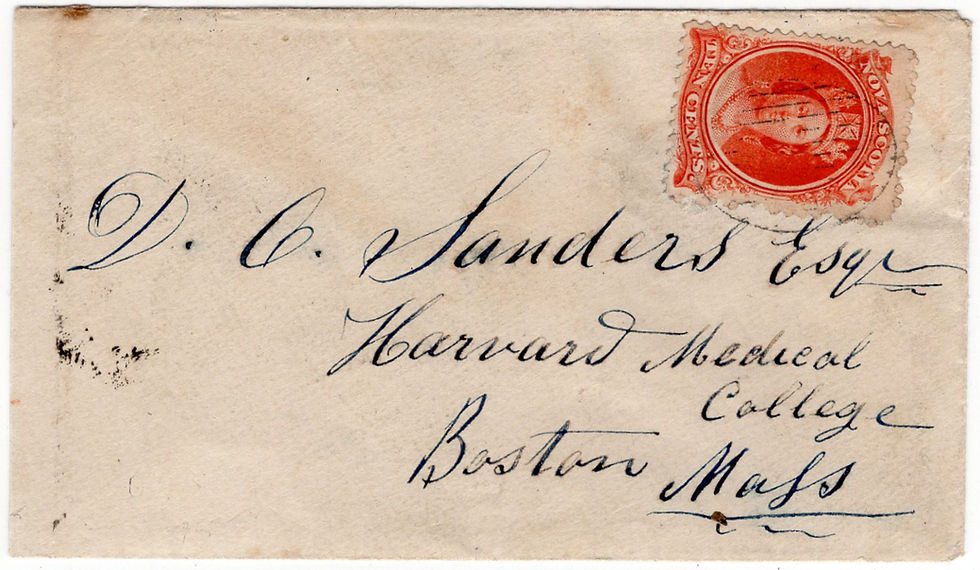
The address, initially read as “D.C.” or “D.G. Sanders,” proved to be a case of both a misread surname and a misread initial. No Sanders family appears in Clementsport records of the period, but a single Saunders family does — and Harvard’s own University Catalogue for 1868–69 settled the matter directly, listing among its medical students: “Saunders, Daniel Oliver, residence - Nova Scotia.” The cover’s addressee was Dr. Daniel Oliver Saunders, then an early-stage medical student, three years before that catalogue entry.
Clementsport
Clementsport was established as Clements Township by United Empire Loyalists from Long Island, New York, who arrived around 1785. Its original boundaries extended southwest to the Bear River, south to what was originally called the Hessian Line (now the Clementsvale Road), and northeast as far as Allain’s Creek at the edge of Annapolis Royal — an area that today includes the villages of Deep Brook and Cornwallis Park (on the site of the former CFB Cornwallis) and Upper Clements Parks. Several homes and churches in the village date to the late 18th and early 19th centuries.

Sitting on the southern shore of the Annapolis Basin along the Moose River, roughly halfway between Annapolis Royal and Digby, Clementsport was in the 19th century a genuinely industrial town — boasting a large mill and ironworks factory, shipbuilding wharves, a customs house, and several hotels catering to merchants doing business in the area; stores and residences were built out over the water on pilings, much as still survives in nearby Bear River. As shipbuilding declined, so did the village’s business opportunities: people stopped moving to the area, and the trade-based economy that had sustained it began to diminish. Most of the central square was later removed in a late-20th-century highway expansion, and a village that had once supported a school, a train station, and numerous general stores gradually dwindled. Long-time residents have described this slow process as a “dismantling of memories” (Tammy Sanford-Hutchinson, 2013, quoted in the Clements Historical Society’s Hidden Village of Clementsport project). Today Clementsport is a small scattering of houses among reforested fields along Highway 1 — a history invisible to anyone simply driving through, though preserved by residents through oral history and shared local memory. More recent economic decline has seen the closure of several local businesses, including a gas station, convenience stores, a pizzeria, art galleries, and a bed and breakfast.
Two branches of one family
Clementsport in this period was home to a prominent seafaring Saunders family, headed by Captain Pardon Saunders (1817–1884), a mariner and shipmaster whose own transatlantic departures and arrivals — New York, Bristol, Liverpool, Hamburg, Saint John — are documented through the 1870s in the Seafarers of the Atlantic Provinces records and Masters and Mates certificates. His family initially suggested a strong Clementsport connection to the cover, but none of his own children carried the name Daniel, or fit a Harvard medical student’s likely age in 1866.
Genealogical research resolved this: Captain Pardon Saunders of Clementsport and Dr. Daniel Oliver Saunders, the cover’s actual recipient, were second cousins, both descended from a common patriarch, Pardon Saunders (1720, Cornwall, England – 1784, Annapolis), who had married Jeanne Hannah Olivier (1733–1824) around 1751. Their two sons founded distinct family lines:
• Pardon Saunders Jr. (1760–1827), married Phebe Dodge — the seafaring branch, continuing through Captain Pardon Saunders (1783–1862) of Clementsport, and his son, the mariner Captain Pardon Saunders (1817–1884).
• Dr. Daniel Oliver Saunders (1761–1849), married Hannah Hicks — the medical branch, continuing through Oliver Saunders (1794–1882) of Granville Ferry and Clarence West, and his son, Dr. Daniel Oliver Saunders (1837–1929), the cover’s recipient — himself named directly for his grandfather.
The given name “Oliver,” recurring across this branch of the family for well over a century, traces back to Jeanne Hannah Olivier, the immigrant patriarch’s wife.
Dr. Daniel Oliver Saunders (1837–1929)
Born May 17, 1837, at Granville Ferry, Annapolis County, the son of Oliver Saunders and Elizabeth “Eliza” Barnaby, who died when he was not yet three. He was about 28 when this cover was sent to him at Harvard Medical College in January 1866, and appears in Harvard’s own catalogue as a medical student as late as 1868–69, listed under instructor R. J. Ellison. Nova Scotia’s official 1880 Medical Register, published under the authority of the Provincial Medical Board, confirms his graduation — “Saunders D. Oliver, M.D., Harvard, Mass, 1869, Getson’s Cove” — placing his degree in 1869 and his practice, a decade later, at Getson’s Cove, Lunenburg County. He appears there alongside dozens of Nova Scotian physicians of his generation trained abroad, at Harvard, McGill, the University of Pennsylvania, Edinburgh, and various New York colleges — Dalhousie’s own Faculty of Medicine, founded in 1868, would not graduate its first class until 1872, so a Nova Scotian of Saunders’s generation seeking a medical degree still had to leave the province to get one. By 1871 he was recorded in Caledonia, Queens County, Nova Scotia, with his occupation given as M.D. He married Annie Letitia McKean on February 17, 1875, at Middle LaHave, Lunenburg County, and settled his medical practice in the LaHave and Conquerall Bank area of Lunenburg County — the same district as Robert West of Bridgewater, recipient of a quite different 1862 cover in this collection. He and Annie had four sons, including Dr. Reginald McKean Saunders (1884–1969), who continued the family’s medical tradition into a fourth generation. Dr. Saunders practiced for decades, recorded as a physician through the 1901 and 1911 censuses, retired by 1921, and died of pneumonia on January 24, 1929, at 91 years, 8 months, and 10 days of age, at Clarence West, Annapolis County — the same small community his father’s family had called home — and was buried at Riverside Cemetery, Bridgetown.
Summary
A cover that at first seemed a simple case of a common surname and an obscure recipient turned out to trace a Cornish immigrant’s descendants across six generations and over two centuries — one branch of sea captains trading across the Atlantic from Clementsport, the other a line of physicians whose eldest namesake, this cover’s own recipient, carried his family’s medical tradition from a Harvard classroom to a career spent among the same Annapolis Valley communities his ancestors had settled generations before.


Comments