
A Business Letter to Arichat: Fever, Repairs, and the Brazil Trade
- 18 hours ago
- 10 min read


Liverpool 18th May 1860
Messrs. De Carteret & de Visconte
Arichat C.B.
Dear Sirs,
We beg to advise you that the Caroline, Captain Adams arrived here from Pernambuco
on the 15th instant. The first officer & two seamen having died of fever. We commence
discharging tomorrow & expect cargo will be in good order.
A few days after leaving Pernambuco Captain Adams found his foremast broken
which must have been done in the gale 26th January, and his other repairs viz wheel house, round house, capstan were not done at Pernambuco. The Captain has written about to Jersey for full instructions, which when received shall be well attended to & effected as cheaply as possible.
Respecting outward cargo we shall no doubt hear from Jersey about. We shall have very great pleasure in rendering Captain Adams all the assistance in our power
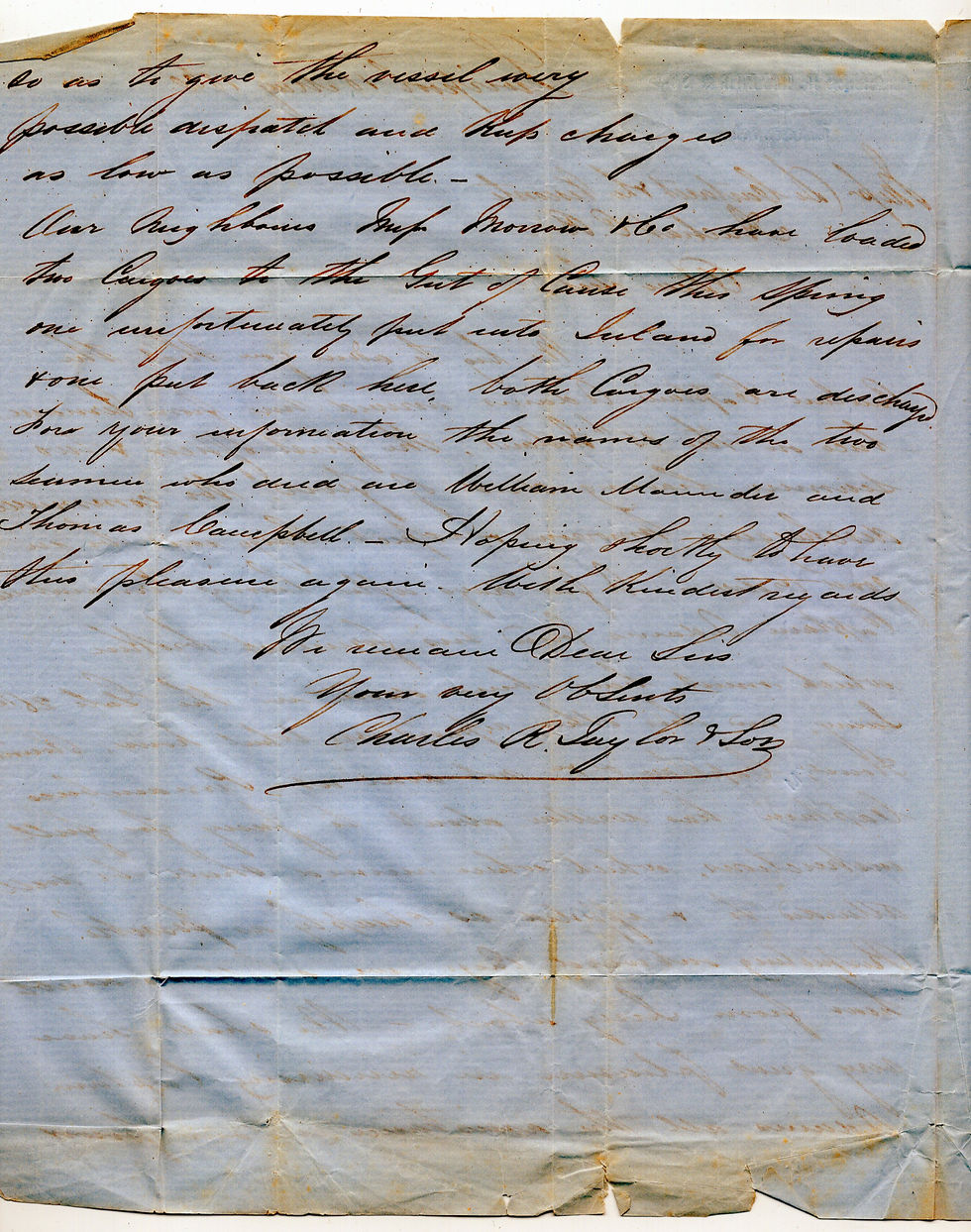
so as to give the vessel every possible dispatch and keep charges as low as possible.
Our neighbors Mr. Morrison & Co have loaded two cargoes to the Gut of Canso this Spring. One unfortunately put into Iceland for repairs & one put back here. Both cargoes are discharged.
For your information the names of the two seamen who died are William Maunder and
Thomas Campbell.
Hoping shortly to have the pleasure again. With kindest regards We remain Dear Sirs
Your very obedient Charles R. Taylor & Sons.
The letter itself
Written and signed by Charles R. Taylor & Son, Liverpool merchants, the letter is business correspondence addressed to the Arichat firm of De Carteret & LeVesconte, reporting on the condition and repair of one of their vessels:
“We beg to advise you that the Caroline, Captain Adams, arrived here from Pernambuco on the 15th instant, the first officer & two seamen having died of fever. We commence discharging tomorrow & expect cargo will be in good order.
A few days after leaving Pernambuco Captain Adams found his foremast broken, which must have been done in the gale 26th January, and his other repairs, viz. wheel house, round house, capstan, were not done at Pernambuco. The Captain has written about to Jersey for full instructions, which when received shall be well attended to & effected as cheaply as possible…
For your information the names of the two seamen who died are William Maunder and Thomas Campbell.”
The letter also mentions a competing firm, Morrison & Co., whose two cargoes bound for the Gut of Canso that spring had run into trouble of their own — one vessel forced into Ireland for repairs, the other turned back to Liverpool — giving a small window onto the ordinary hazards and rivalries of the transatlantic trade in this period.
The gale of January 26
Captain Adams’s report of a broken foremast dates the damage to “the gale 26th January” — and the shipping record for that single day bears out just how severe the weather was across the Atlantic that winter. Wikipedia’s compiled list of shipwrecks records roughly thirty vessels lost, wrecked, or driven ashore on January 26, 1860 alone, an unusually heavy toll concentrated on Britain’s east coast — eight ships wrecked at Robin Hood’s Bay, Yorkshire, in that single day (the Athens, Earl Bathurst, Emily, Hebe, Marion, Miriam, Swan, and Veronica), with further losses off Donaghadee, Ireland, the North Sea coasts of Lincolnshire, Suffolk, and Kent, and as far afield as Le Conquet, France (the Dinapore, with loss of life) and Terschelling in the Netherlands. The Liverpool Mercury ran the story under the heading “The Late Gales” that same day. Whether the Caroline, presumably then somewhere off the South American coast on her homeward run from Pernambuco, encountered this same weather system or a separate but contemporaneous one further south, the record confirms that late January 1860 was an exceptionally violent period across the wider Atlantic — corroborating, in broad terms, the severity Captain Adams reported to his owners.
Fever at sea
The deaths reported so matter-of-factly in this letter — a first officer and two seamen lost to fever on the run up from Pernambuco — reflect one of the great, largely unavoidable occupational hazards of the tropical trade in this period. European and North American sailors carried no natural immunity to yellow fever, malaria, and related tropical fevers endemic to Brazilian, Caribbean, and West African ports, and mortality among “seamen and strangers” in these climates was consistently far higher than among long-term local residents. Ships calling at ports like Pernambuco, Rio, or Havana routinely lost crew to fever contracted ashore or during loading, with the disease then sometimes spreading aboard ship during the homeward Atlantic crossing — precisely the sequence implied by the Caroline’s losses on her run north. The causes of yellow fever and its transmission by mosquito were not established until Walter Reed’s work at the turn of the twentieth century; through the whole of the nineteenth century, ships’ officers and merchants alike could do little more than report deaths after the fact and hope a vessel’s remaining crew and cargo arrived safely, exactly as Charles R. Taylor & Son do here.
Nova Scotia’s own shipping annals include a notable case from the same general trade only a decade later: in 1870, Bessie Hall of Granville Beach, Annapolis County — sailing with her father, Captain Joseph Hall, aboard the ship Rothesay from New Orleans to Liverpool — nursed the vessel through a shipboard smallpox outbreak that struck down her father and the crew in turn, ultimately taking command herself and navigating the fever-stricken ship safely across the Atlantic. Fever crises of this kind, whether yellow fever, smallpox, or the generic “fever” reported in this letter, were simply an accepted risk of the long-distance trade that firms like De Carteret & LeVesconte and their Nova Scotia neighbors relied on for their livelihoods.
De Carteret & LeVesconte, and the Jersey–Arichat trade
The Channel Islands, and Jersey in particular, had long-standing commercial and fishing interests in the North Atlantic fishery, and firms based there operated extensively out of Arichat, on Isle Madame at the Strait of Canso — a center of that trade.

Isaac LeVesconte (1822–1879), born at St Aubin’s, Jersey, son of Peter LeVesconte and Jane Malzard, emigrated to Arichat at age 12 to work for the family firm of DeCarteret and LeVesconte. The firm shipped fishery supplies, salt, clothing, and manufactured goods from Europe for the use of local fishermen and their families, exported dry fish to Brazil and the West Indies in its own vessels, carried return cargoes of wine from Brazil to England, and brought molasses, sugar, and rum from the West Indies to Nova Scotia — precisely the transatlantic, multi-leg trading pattern the Caroline’s voyage from Pernambuco, Brazil, reflects.
LeVesconte captained one of the firm’s own ships to Puerto Rico at just 17, and around 1855, when Peter DeCarteret returned to Jersey, he was placed in charge of the Arichat business — meaning that by the time this letter was written in May 1860, LeVesconte himself was very likely the firm’s senior figure in Arichat, the “Dear Sirs” to whom Charles R. Taylor & Son’s Liverpool report was addressed.
Peter DeCarteret, the Jersey partner
Isaac’s partner was Peter DeCarteret (1786–1875), son of Jean DeCarteret and Rebecca Rauland of New Rochelle, France. An 1827 Cape Breton land petition records DeCarteret and Le Vesconte jointly as “natives of the Island of Jersey… engaged in trade as De Carteret and Le Vesconte,” DeCarteret then 38, married, with four children, seeking a land grant on Isle Madame. The partnership was also a family one: DeCarteret married Isaac LeVesconte’s sister, Elizabeth Jane LeVesconte (1824 – c. 1880), making the two men brothers-in-law as well as business partners.
The St Helier parish marriage register records the wedding itself: Peter DeCarteret, age 56, Bachelor, Merchant, married Jane Elizabeth LeVesconte, age 21, Spinster, on May 21, 1846, in the parish of St Helier. His recorded status as a bachelor at marriage — this being, in other words, his first marriage — sits awkwardly against the 1827 Cape Breton land petition’s description of a Peter DeCarteret as “38 years old, married, with four children” in that year; the two records most likely describe different men of the same name, perhaps father and son, rather than a single individual, though nothing found here settles the question definitively. Working back from his age at this 1846 marriage puts Peter DeCarteret’s own birth in the late 1780s, broadly consistent with, if not identical to, the birth years given elsewhere.
The 1861 England census, taken at Great Union Road, St Helier, fifteen years after the marriage, independently confirms the resulting household: Peter DeCarteret, head, married, age 73, occupation merchant, born St Brelade, Jersey; his wife “Jane Eliz.”, age 37 (a birth year of about 1824, matching Elizabeth Jane LeVesconte precisely, her given names simply recorded in reverse order); and their son Peter John, a scholar, age 18. That makes Peter John’s birth year about 1843 by this census, rather than the 1850 given in some family-history sources — quite possibly a case of an earlier son later confused in family memory with a younger brother of the same name, a known pattern in Victorian families after the death of an infant, though the records available here don’t settle the question either way.
His baptismal record survives at the chapel of St Aubin, Jersey: “Pierre, fils de Jean De Carteret & de Rebecca Rauland sa femme,” baptized September 17, 1786 — a precise date that supersedes the approximate birth years given by the later census and marriage records, both of which, as is typical of self-reported ages in this period, drift somewhat from it.
DeCarteret’s own presence in Arichat is independently documented well before his 1846 marriage: an 1838 Arichat census lists “Peter DeCarteret… merc[han]t,” heading a household of 15 — a notably large establishment, likely including live-in clerks or employees of the firm alongside family, and confirming he was already settled and active in Arichat while Isaac LeVesconte was still a teenager newly arrived from Jersey. Nova Scotia vessel registration records also list Peter DeCarteret, merchant of Arichat, as owner and builder of the schooner Two Brothers, built in 1840 and registered at Sydney, holding 32 of the vessel’s 64 shares — concrete evidence, alongside the description in his eventual will, that the firm’s business extended to building and owning vessels outright, not merely chartering or using others’ ships for its trade.
While Isaac ran the Arichat side of the firm from 1855 on, Peter DeCarteret managed its Jersey end, and the family divided its time between Jersey, Arichat, and Paris. His will, dated November 9, 1870, and recorded in Jersey on October 2, 1875, describes him at his death as “of St Brelade, now of Cannes, Department of Var, France, former merchant and ship owner” — his final years spent on the French Riviera rather than in Switzerland, as one family-history source suggests; the two accounts may simply reflect different periods of his retirement. Their son, Peter John DeCarteret, married Emma Henrietta Cave, daughter of a baronet who later served as Chancellor of the Exchequer in the Lloyd George government — the family’s later generations moving in considerably more elevated circles than the firm’s original Arichat fish trade.
A Nova Scotia–Caribbean/South America–Channel Islands trade
The Caroline’s voyage — outbound cargo to South America, a call at Pernambuco, and a return leg to Liverpool — sat within a long-established, three-cornered pattern of trade that Channel Islands firms like De Carteret & LeVesconte had adapted from the broader Atlantic fishery trade practiced across the whole of British North America. Nova Scotia and Newfoundland merchants shipped dried and salted cod to Brazil, the West Indies, and southern Europe, since none of those warm-climate regions produced much fish of their own but all needed an affordable, well-preserved source of protein; Brazil in particular took the lower “Madeira” grades of cod, while the West Indies took the cheapest cure of all. In return, these markets supplied exactly the commodities the letter’s own cargo lists reflect: the West Indies sent back sugar, molasses, and rum; Brazil offered coffee, cotton, and wine; and the Channel Islands and other European ports supplied salt — essential for curing the next season’s catch — along with clothing and manufactured goods for the fishing communities the firm supplied. A Nova Scotia Museum of Industry account of the province’s merchant economy in this period describes the same basic circuit: “Nova Scotia’s merchants sold fish to the West Indies, bringing back rum and molasses… It was a pattern of trade that worked well for generations,” sustaining a solid mercantile elite, Cunard among them, without producing many truly large fortunes.
Jersey and Guernsey firms had operated this circuit out of Cape Breton ports like Arichat since the late eighteenth century, running their own vessels between Europe, the Gulf of St. Lawrence fishery, and the Caribbean and South American markets, with young Jersey-born clerks — LeVesconte among them — sent out as boys to learn the business on the Cape Breton end before eventually taking charge of it themselves. The Caroline’s call at Pernambuco, her cargo, and her return to Liverpool for onward correspondence to Arichat “via Halifax” all trace one full circuit of this same long-running trade.
Well regarded locally for his business acumen and his knowledge of the Bible and the law, LeVesconte was often consulted by Arichat’s fishermen. He entered politics as a Conservative, elected to the Nova Scotia Legislative Assembly in 1863 for Richmond County, and served briefly as financial secretary in the Johnston–Tupper administration (June 1863 – December 1864). A Protestant representing a largely Roman Catholic county, he played a prominent role in the 1864 legislative debate on free schools, and in 1865 moved an unsuccessful amendment for separate schools. In December 1865 he was appointed, together with his successor as financial secretary, James MacDonald, to represent Nova Scotia on a commission sent by the British North American colonies to open trade relations with the West Indies, Mexico, and Brazil — a natural extension of the very trade this 1860 letter documents. He was elected to the House of Commons for Richmond in an 1869 by-election, serving until his retirement ahead of the 1874 general election; Joseph Howe, not entirely flatteringly, remarked that he “was a queer fish who drank too much.” LeVesconte married Caroline Susan Jean and had a daughter, Caroline; he died at Arichat on October 26, 1879. His grandson, Isaac Duncan MacDougall, later served ten years as federal MP for Inverness.
Other Arichat covers on this site
This letter sits within a small, tightly interconnected cast of Richmond County figures covered elsewhere on this blog, all drawn from the same narrow window of about 1860–1871:
• Miss Euphemia Jane Ferrier of Arichat — daughter of another Arichat merchant and shipowner, John Ferrier, owner of the schooners Margaret and Messenger
• William Reynolds Cutler, Lawyer — an Arichat barrister descended from a Massachusetts Loyalist family, married and buried at St. John’s Anglican Church
• Maximin Forest, Acadian Merchant — a commission merchant from one of Arichat’s leading Acadian Catholic families, the community’s other great mercantile network alongside the Anglican/Channel Islands merchants
• Henry Carrie, Justice of the Peace — a Guernsey-born merchant at nearby River Bourgeois, echoing LeVesconte’s own Channel Islands origins, who received official correspondence from the Clerk of the Peace in Arichat, the county seat
Together with this cover, they sketch the merchant, legal, and administrative fabric of one small port — Loyalist, Acadian, and Channel Islands families alike, doing business and keeping the peace within a few miles of one another.
Summary
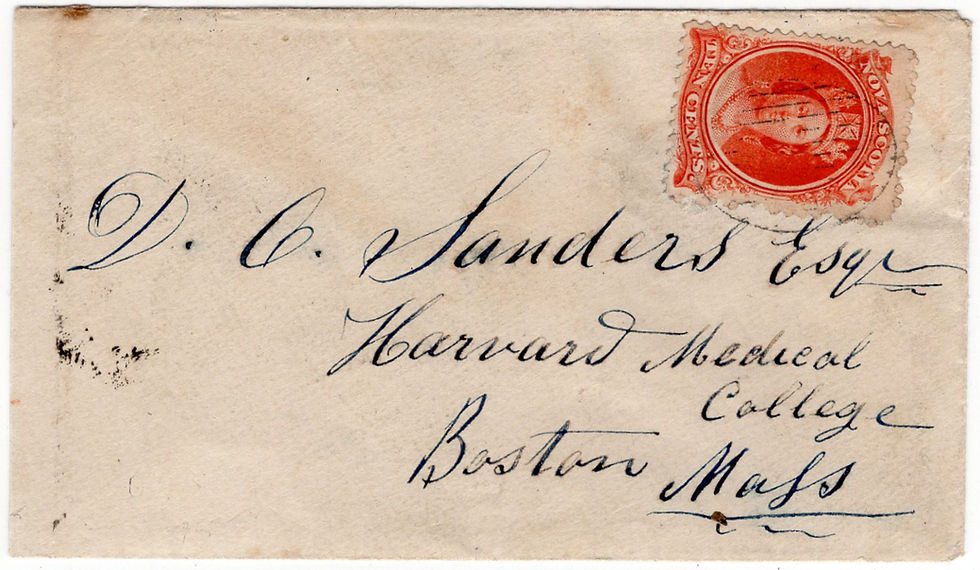
This cover captures a moment of routine but consequential business for a Jersey-descended trading firm at the height of Arichat’s involvement in the transatlantic fish, salt, and rum trade — a report on a fever-stricken crew, storm damage, and cargo, addressed to the very man, Isaac LeVesconte, who would soon leave the counting house for the Nova Scotia Legislative Assembly and eventually Ottawa.


Comments